0
Short Stories. Illustrated Edition
, , ,

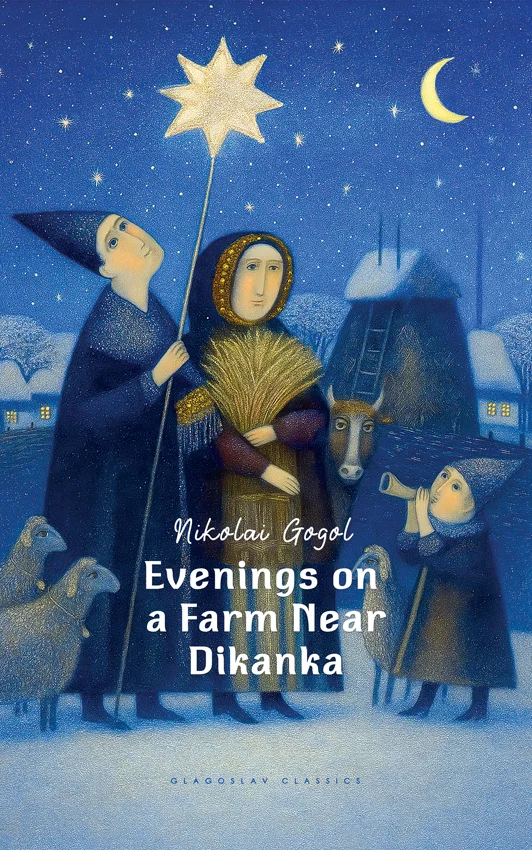
Evenings on a Farm Near Dikanka

22.50

Gogol’s debut collection blends Ukrainian folklore, satire and the supernatural in vivid tales of devils, ghostly maidens, and village mischief — newly edited and illustrated for today’s reader. Edited by Robert Romanchuk, Pribic Family Associate Professor of Slavic at Florida State University, it is scheduled for publication in early 2027.

Choose a format
Translated by Constance GarnettEdited by Robert Romanchuk
Pre-order· Expected January 2027

Step into the vibrant world of Nikolai Gogol’s Evenings on a Farm Near Dikanka, the extraordinary debut that has enchanted and amused readers for nearly two centuries.
Immerse yourself in early nineteenth-century Ukraine: a land of sun-drenched afternoons and moon-bewitched nights, where old folk songs fill the air, mischievous devils haggle for souls, and village laughter mingles with the eerie whispers of water sprites. Young Gogol blends infectious humour, supernatural thrills, and unforgettable characters, all framed by the warm narration of the beekeeper Rudy Panko.
The collection ranges across the bustling “Fair at Sorotchintsy,” the devil-outwitting blacksmith in “Christmas Eve,” and the chilling horror of “A Terrible Revenge.” Pushkin praised the book on its release. In these tales the ordinary and the fantastical dance a lively jig.

This new edition builds on Constance Garnett’s pioneering translation, its archaic phrasing gently smoothed so that Gogol’s imagination and Garnett’s achievement reach a new generation. Edited by Robert Romanchuk, Pribic Family Associate Professor of Slavic at Florida State University, it is scheduled for publication in early 2027.

Why read Evenings on a Farm Near Dikanka today?

  • For the joyful, unabashedly fantastical wellspring of one of literature’s most original voices.
  • For a vivid window into Ukrainian culture and its folkloric traditions.
  • For the pleasure of hearty laughter, real wonder, and a cast of human, demonic, and spectral characters only Gogol could have conjured.

Accept Rudy Panko’s invitation to a literary feast that has delighted readers generation after generation.
Dimensions 152 × 229 mm
Author

Nikolai Gogol

Pages

… pages

Publication date

January 2027

Book Format

Hardcover, Paperback

Author

Nikolai Gogol

Nikolai Gogol (1809-1852) remains one of world literature's most profound enigmas, a Ukrainian-born writer whose laughter often masked deep melancholy and whose meticulous realism was frequently infused with the grotesque and supernatural. His fervent spiritual quest ultimately led to a tragic end.

Born in Sorochyntsi, Ukraine, Gogol's heritage deeply influenced his early work. His father wrote Ukrainian comedies, and his mother's religious, superstitious nature, along with regional folklore, provided rich material. Educated at home and then the Nizhyn Lyceum (1821-1828), he developed his literary inclinations, participating in theatre and beginning to write, absorbing Romantic influences and the vibrant Ukrainian culture.

Arriving in St. Petersburg in 1828, Gogol faced initial disappointment. His self-published poem Hans Küchelgarten (1829) was a critical failure, which he famously burned. Brief, disillusioning stints in the civil service provided fodder for later satires. His breakthrough came with Evenings on a Farm Near Dikanka (1831-1832), celebrated for its vibrant Ukrainian folklore, humor, and supernatural elements. This period also saw him enter Alexander Pushkin's influential literary circle, gaining crucial mentorship.

Gogol's creative output flourished. Mirgorod (1835), with stories like "Taras Bulba" and "Viy," showed growing depth. Arabesques (1835) included seminal "Petersburg Tales" like "Nevsky Prospekt" and "Diary of a Madman," exploring urban alienation. His comedic masterpiece, The Government Inspector (1836), a biting satire of provincial corruption, caused an uproar. He also began his epic, Dead Souls.

Disheartened by reactions to his play, Gogol left Russia in 1836, spending twelve years abroad, mostly in Italy. He completed Dead Souls, Part I (published 1842), a satirical sensation depicting a conman buying titles of deceased serfs. However, Gogol grew increasingly preoccupied with sin and redemption, viewing his work as a divine mission. His 1847 publication, Selected Passages from Correspondence with Friends, a didactic and reactionary work, was widely condemned, deeply wounding him. He fell under the influence of the stern priest Father Matvey Konstantinovsky, who reportedly discouraged fiction.

Returning to Russia in 1848, Gogol was tormented by spiritual anguish. A pilgrimage to Jerusalem brought little peace. He struggled with Dead Souls, Part II, which he envisioned as a redemptive arc. In a spiritual crisis in February 1852, influenced by Father Matvey, he burned the manuscript. He then refused food and succumbed to self-neglect, dying in Moscow on March 4, 1852, aged forty-two.

Gogol is a foundational figure of Russian literature, profoundly influencing writers like Dostoevsky ("We all came out from Gogol’s ‘Overcoat’"). He masterfully blended high rhetoric with colloquial speech, irony, and the grotesque, fusing the mundane with the fantastical. The enigma of Gogol—the brilliant satirist who yearned to be a spiritual prophet, dying in despair—continues to fascinate, his work a testament to the tension between the ideal and the real.