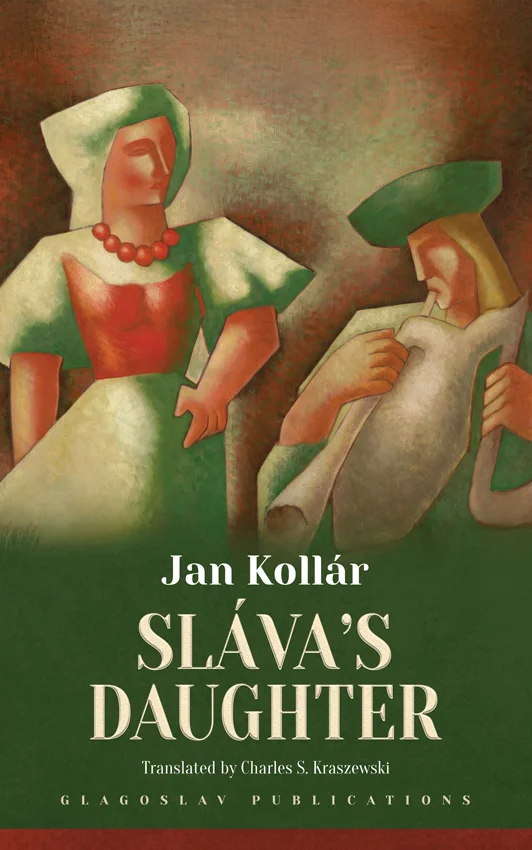
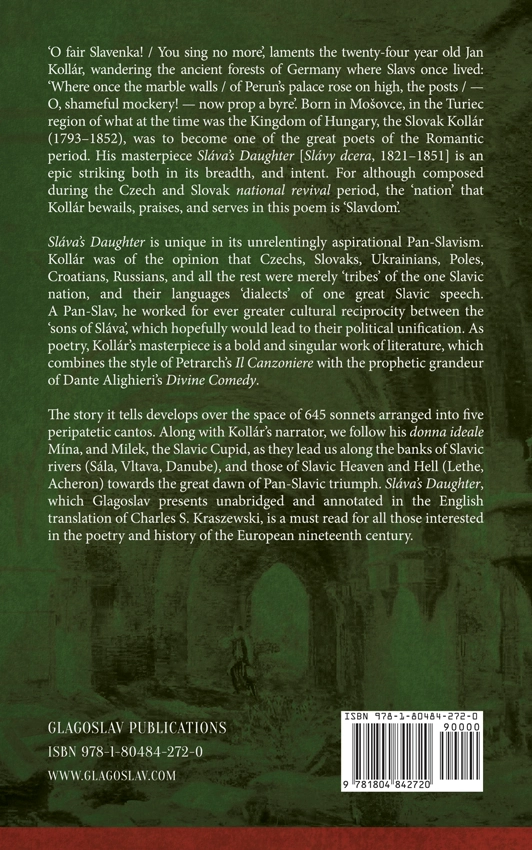
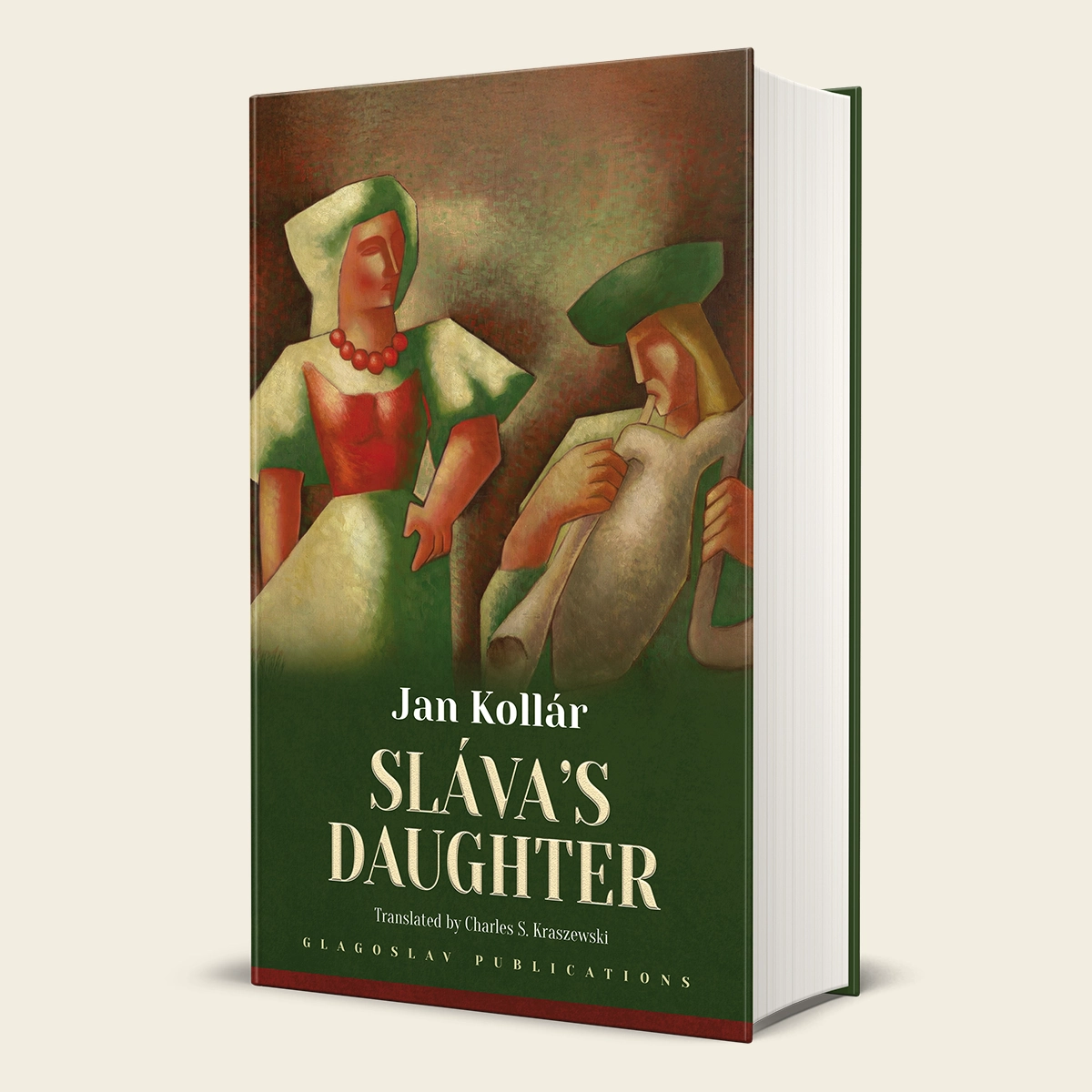
‘O fair Slavenka! / You sing no more’, laments the twenty-four year old Jan Kollár, wandering the ancient forests of eastern Germany where Slavic tribes once lived, ‘Where once the marble walls / of Perun’s palace rose on high, the posts / — O, shameful mockery! — now prop a byre’. Born in Mošovce, in the Turiec region of what at the time was the Kingdom of Hungary, the Slovak Kollár (1793–1852), was to become one of the most interesting and significant poets of the Romantic period, and turn his lament into Sláva’s Daughter [Slávy dcera, 1821–1851] an epic striking both in its breadth, and intent. For although composed during the Czech and Slovak national revival period, the ‘nation’ that Kollár laments, praises, and serves in his masterpiece is ‘Slavdom’.
Sláva’s Daughter is unique in its unrelentingly aspirational Pan-Slavism. At a time of increasing Germanisation and Magyarisation in multi-ethnic empires such as Habsburg Austria-Hungary, the Czech and Slovak subjects of Vienna and Budapest began more forcefully to assert their ethnic identities. Their renewed, and active, interest in their native tongues and traditions led to a blossoming of Czech and Slovak culture known as the national revival. Kollár, however, was of the opinion that Czechs, Slovaks, Ukrainians, Poles, Croatians, Russians, and all the rest were merely ‘tribes’ of the one Slavic nation, and their languages ‘dialects’ of one great Slavic speech.
A Pan-Slav, he worked for ever greater cultural reciprocity between the ‘sons of Sláva’, which hopefully would lead to their political unity: ‘What will be with the Slavs a century /from now?’ he muses toward the end of Canto III, foretelling a great future before the united Slavic nation, taking their rightful position on the world stage. As ideology, Sláva’s Daughter is sweeping in scope. In encyclopaedic fashion, it recounts the history, both glorious and fatal, of all the Slavic nations since the early middle ages, and calls the contemporary Slavs to rise from their knees and work together for the splendid future that awaits those faithful to their ‘mother’ Sláva.
As poetry, Kollár’s masterpiece is a bold and singular work of literature, which combines the style of Petrarch’s Il Canzoniere with the prophetic grandeur of Dante Alighieri’s Divine Comedy, as its story develops over the space of 645 sonnets arranged into five peripatetic cantos. Along with Kollár’s narrator, we follow his donna ideale Mína, and Milek, the Slavic Cupid, as they lead us along the banks of Slavic rivers (Elbe, Vltava, Danube), and those of Slavic Heaven and Hell (Lethe, Acheron) towards the great dawn of Pan-Slavic triumph. Sláva’s Daughter, which Glagoslav presents unabridged and annotated in the English translation of Charles S. Kraszewski, is a must read for all those interested in the poetry and history of the European nineteenth century.
This book was published with a financial support from SLOLIA, Centre for Information on Literature in Bratislava.