The History of Belarus: From Polotsk to Independence
The history of Belarus is the history of a European people who spent close to a thousand years inside other people’s states without dissolving into them. Its lands were settled by Slavic tribes in the early Middle Ages, produced the principalities of Polotsk and Turov within Kievan Rus, and then formed the demographic and legal core of the Grand Duchy of Lithuania, whose chancery language was an early form of Belarusian. From the end of the eighteenth century the country belonged to the Russian Empire, was divided between Poland and Soviet Russia in 1921, lost roughly a quarter of its population in the Second World War, and declared independence in 1991. What holds this long chronology together is not one unbroken state but one persistent question: who the Belarusians are, and in whose language they should answer it.
Where does the history of Belarus begin?
Geography is the first thing to understand. Belarus has no mountains and no coastline: it is a flat country of forest, bog and slow rivers, and those rivers are the reason it was ever contested at all. The Western Dvina and the Dnieper carried traffic between the Baltic and the Black Sea, while the Pripyat marshes in the south were a barrier armies preferred to go around. Settlements grew on the portages, and whoever held the portages held the trade.
Between roughly the sixth and ninth centuries, Slavic tribal unions moved into this landscape and absorbed its earlier Baltic-speaking inhabitants: the Kryvichy along the Dvina, the Dryhavichy in the marshy centre and south, the Radzimichy on the Sozh. The Baltic substratum never quite vanished, surviving in river names and in a good deal of scholarly argument. Christianity arrived with the conversion of Kievan Rus at the end of the tenth century, though it took generations to reach the villages, and the older seasonal rites moved into the church calendar rather than out of it.
Polotsk and the first principalities
Polotsk appears in the chronicles under the traditional date of 862, which makes it one of the oldest towns in the eastern Slavic world. By the tenth century it had its own ruling house under Prince Rahvalod, whose defiance of Kiev ended badly: the town was taken, Rahvalod killed and his daughter Rahneda married by force to Vladimir of Kiev. Their son Iziaslav was sent back to rule Polotsk, and from him descended a dynasty that spent the next two centuries behaving less like a branch of Kiev than like a rival to it.
The most striking of that line was Vseslav Bracyslavich, remembered as Vseslav the Sorcerer, who ruled from 1044 to 1101 and briefly held Kiev itself in 1068 after being freed from prison by a city revolt. Under him Polotsk built its own Cathedral of St Sophia, deliberately named after the cathedrals of Kiev and Novgorod and announcing, in stone, that Polotsk considered itself their equal. To the south, the principality of Turov produced Cyril of Turov, a twelfth-century bishop whose sermons are among the finest surviving prose of the period. Polotsk also produced Euphrosyne, a princess who became a nun, founded monasteries and scriptoria, and commissioned in 1161 the jewelled cross made by the craftsman Lazar Bohsha, an object that vanished during the Second World War and has been searched for ever since.
This is the period later Belarusian historians return to whenever they need to show that statehood here was not an import. Polotsk made its own policy, fought its own wars, and lay far enough north and west to survive the Mongol campaigns of the 1240s that shattered the south.
The Grand Duchy of Lithuania: a Belarusian golden age?
In the thirteenth century a new power consolidated in the lands between the Nioman and the Vilia, traditionally associated with Navahrudak, and by 1253 its ruler Mindaugas had been crowned king. The Grand Duchy of Lithuania that grew from it expanded east and south with remarkable speed, and within a century most of its territory and subjects were Slavic-speaking and Orthodox rather than Baltic and pagan.
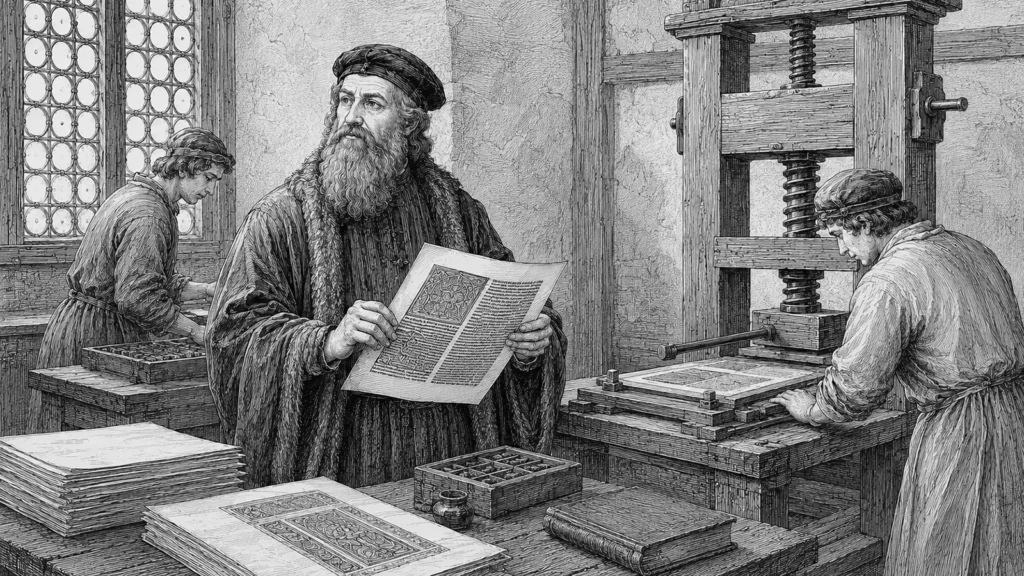
That balance shaped the state. The language of its chancery, its charters and its courts was Ruthenian, the written idiom from which both modern Belarusian and modern Ukrainian descend. The three Statutes of the Grand Duchy, issued in 1529, 1566 and 1588, were drafted in it, and the 1588 Statute is one of the more sophisticated legal codes produced anywhere in sixteenth-century Europe: it limited the ruler, protected noble privilege, and stayed in force here for centuries. In 1517 Francysk Skaryna, a doctor of medicine from Polotsk trained at Krakow and Padua, began printing books of the Bible in Prague in a language his countrymen could actually read, and later set up a press in Vilnius.
Whether all this amounts to a Belarusian golden age is the oldest argument in Belarusian historiography, and it is not a settled one. The counter-case is straightforward. The Union of Krewo in 1385 tied the Grand Duchy to Poland; the Union of Lublin in 1569 merged the two into the Polish-Lithuanian Commonwealth; the Union of Brest in 1596 placed most of the Orthodox population under Rome as Greek Catholics. Over the following century the nobility became Polish in language, dress and outlook, and in 1696 the Commonwealth formally replaced Ruthenian with Polish in official use. A culture that had run the paperwork of a large European state was pushed down into the villages, where it survived as speech rather than as writing.
Between Poland and Russia: the partitions
The seventeenth century was ruinous. The wars between the Commonwealth and Muscovy in the middle of the century, followed by the Great Northern War, cost these lands a catastrophic share of their population and left towns that had been prosperous trading centres reduced to villages with charters. The Commonwealth never fully recovered, and in three partitions in 1772, 1793 and 1795 it ceased to exist. Almost all of the Belarusian lands passed to the Russian Empire.
Imperial policy treated the region as a western borderland to be integrated rather than a country with a history. The Greek Catholic Church, to which most of the peasantry belonged, was abolished at the Synod of Polotsk in 1839 and its parishes transferred to Orthodoxy. After the uprising of 1830 and 1831 the University of Vilna was closed. After the far larger rising of 1863 and 1864, whose leader in these lands was Kastus Kalinouski, repression was systematic: Kalinouski was hanged in Vilna, estates were confiscated, and printing in Belarusian, particularly in the Latin alphabet Kalinouski used for his underground paper Peasants’ Truth, was effectively suppressed. These lands also lay inside the Pale of Settlement, and towns such as Minsk, Vitebsk, Hrodna and Pinsk were substantially Jewish. The countryside was Belarusian-speaking; the towns spoke Yiddish, Polish and Russian; the paperwork was Russian.
A national movement nonetheless emerged at the turn of the twentieth century, and it emerged, characteristically, through a newspaper. Nasha Niva, published from 1906 to 1915, gave Belarusian a modern literary standard and a readership, and printed the early work of the poets Yanka Kupala and Yakub Kolas, who remain the two names every Belarusian schoolchild learns. For readers who want this whole sequence set out properly rather than in summary, Lubov Bazan’s A History of Belarus follows it in full, and is unusually careful to lay out the competing interpretations rather than pick one.
The twentieth century: war, borders and loss
The Belarusian People’s Republic was declared on 25 March 1918, in a country under German occupation, and never controlled its own territory; the date is still marked as Freedom Day. A Soviet Belarusian republic followed in 1919. The Treaty of Riga of 1921 then drew a border straight through the Belarusian lands, leaving the west under Poland and the east under Soviet rule, an arrangement that lasted until 1939 and produced two rather different experiences of the interwar decades.
In the east the 1920s brought Belarusianisation: schools, publishing, an academy of sciences, a deliberate state effort to build a national culture. The 1930s reversed it with extraordinary violence. Writers, linguists, teachers and officials were arrested and shot in successive waves, and the mass graves at Kurapaty outside Minsk remain the emblem of that decade.
Then came the war, which fell on Belarus harder than on almost anywhere else in Europe. Occupation lasted just over three years. The Jewish population was murdered nearly completely, the Minsk ghetto among the largest in the occupied east. Many hundreds of villages were burned with their inhabitants inside, of which Khatyn, destroyed in March 1943, became the memorial for all the rest. A very large partisan movement operated in the forests, and the reprisals were indiscriminate. Estimates of the total loss vary, but a quarter of the population is the figure most often given. Minsk was left in ruins and rebuilt almost from nothing.
Post-war Belarus was industrialised rapidly, becoming a producer of tractors, lorries, electronics and chemicals, and its cities filled with people who had moved in from the villages and adopted Russian as the language of urban life. The republic held a founding seat at the United Nations from 1945. In 1986 the reactor at Chernobyl, just over the southern border, exposed Belarus to a large share of the fallout, contaminating agricultural districts in the south-east and creating a public health legacy that shaped the late 1980s politically as well as medically.
Independent Belarus since 1991
The Supreme Soviet of the republic declared state sovereignty on 27 July 1990 and full independence on 25 August 1991. That December, in the Belavezhskaya Pushcha forest on the Polish border, the leaders of Belarus, Russia and Ukraine signed the agreement that dissolved the Soviet Union. Belarus began the 1990s with the white-red-white flag and the Pahonia coat of arms, both drawn from the heraldry of the Grand Duchy.
A new constitution in 1994 created a presidency, and the first election that year was won by Alexander Lukashenko, who has held the office since. A referendum in 1995 replaced the state symbols with variants of the Soviet-era flag and emblem and gave Russian equal official status alongside Belarusian, decisions as much about historical narrative as about administration. Belarusian remains a state language but is used by a minority in daily urban life, and the argument over which past the country should claim has never been resolved. The disputed presidential election of 2020 and the protests that followed brought that argument back into the open and sent a substantial part of the country’s cultural and professional class abroad.
How to read Belarusian history
Several threads run through the whole chronology, and noticing them makes the dates far easier to hold:
- Statehood without a state. Belarusians have spent most of their recorded history as a constituent people of larger polities, which is why the argument over which of those counts as theirs matters so much.
- Language as the battleground. Ruthenian ran a European state and was pushed out of official use in 1696; Belarusian was suppressed after 1864, standardised after 1906, promoted in the 1920s, punished in the 1930s and contested again after 1995.
- Faith as a border. Orthodox, Greek Catholic and Roman Catholic allegiances were repeatedly redrawn from above, most decisively in 1596 and 1839, and each redrawing changed who belonged where.
- Extraordinary demographic loss. The mid-seventeenth-century wars, the repressions of the 1930s and the Second World War each removed a large fraction of the population.
- A borderland outsiders keep renaming. White Rus, the North-Western Territory, the western borderlands: labels applied from outside shaped how the place was governed and how little of it was written down.
Further reading
Very little of this has been available in English at any length, which is precisely the gap that Lubov Bazan set out to close. A History of Belarus: Europe’s Overlooked Nation, translated by Callum Walker, gives the full chronological narrative from the early Slavic settlements to the twenty-first century, and it does so without dictating conclusions: where historians disagree about identity, language and faith, Bazan sets out the competing views and leaves the reader to weigh them. Bazan was born in Vitebsk and directed the city’s Marc Chagall Museum before settling in the Netherlands, which shows in the book’s attention to culture as well as to chronology.
Readers who would rather approach the same history through its literature will find Belarusian novels and poetry in English translation on our Belarusian books shelf, including Ales Adamovych’s Khatyn, Vasil Bykau’s Alpine Ballad and Uladzimir Karatkevich’s King Stakh’s Wild Hunt.