Lviv in Books: A Reader’s Walk Through the City of Lions
Lviv is a literary city in a precise and slightly awkward sense: it has been described, argued over and mythologised in Ukrainian, Polish, German and Yiddish, often by writers who lived a few streets apart and disagreed entirely about what the place was. That argument is still legible in the buildings, and it is what gives the city’s fiction its unusual density. A reader who wants to meet Lviv in English can do it through three novels on our list. Yuri Vynnychuk takes the city in 1938, when it was Lwów, multilingual and a year away from catastrophe, and reads it as crime; Michael M. Naydan takes the contemporary city across two books and reads it first as a quest, then as a return.
None of the three is a guidebook, which is why they work together. Lviv rewards fiction because its layers are not buried: one square can hold an Armenian cathedral begun in the 1360s, Habsburg shopfronts, Polish interwar lettering surfacing through the paint, and a Ukrainian city going about its Tuesday. A novel moves through all of that in a paragraph. A history has to stop and explain it.
Why does Lviv have so many names?
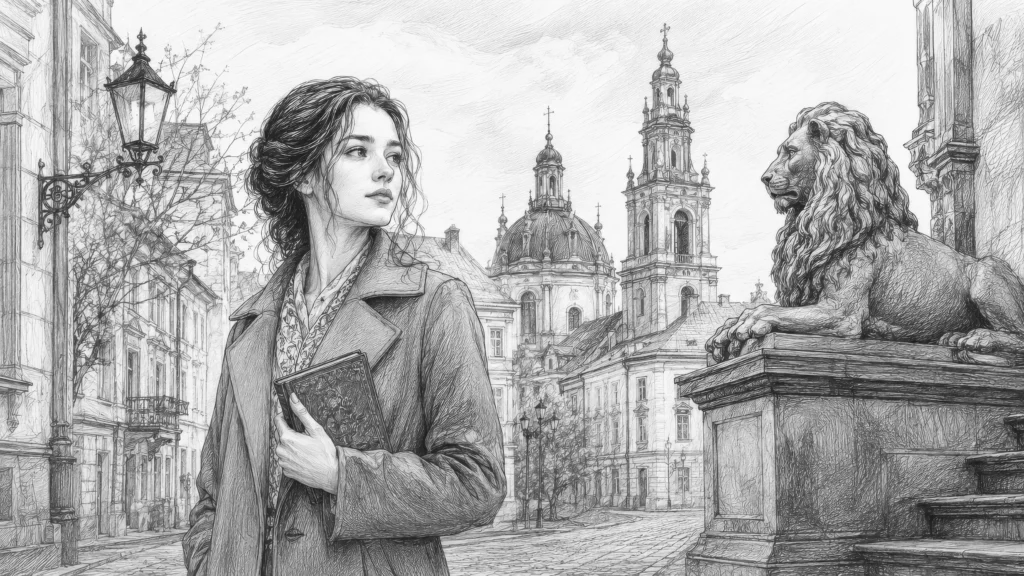
The city was founded in the middle of the thirteenth century by Danylo of Halych, ruler of the Galician-Volhynian state, and named for his son Lev. Lev means lion, which is why the lion is on everything here and why the place calls itself the city of lions. Latin documents made it Leopolis. Under the Polish Crown it was Lwów, a chartered merchant town granted Magdeburg rights in 1356. The first partition of Poland in 1772 handed it to the Habsburgs, who called it Lemberg and made it the capital of Galicia and Lodomeria for close to a century and a half. It returned to Poland after the First World War, became part of Soviet Ukraine after the Second, and has been the Ukrainian city of Lviv since 1991.
These are not decorative variants of one name. Each belonged to an administration with its own language of record and its own view of who the population was, and the handovers were rarely gentle. Hence the crowding: several literatures were produced in the same streets at once, and for long stretches they were not reading one another.
Coffee houses, the Ossolineum and the old quarters
Habsburg rule gave Lviv the café, and the café gave it somewhere to argue. The most celebrated example is not literary at all: at the Scottish Café, mathematicians including Stefan Banach and Stanisław Ulam worked problems out on the marble table tops until Banach’s wife supplied a notebook, and the resulting Scottish Book became one of the famous documents of twentieth-century mathematics. Journalism and poetry ran on the same habit. People worked in public, over coffee, and the fiction set here has never lost that sound.
The Ossolineum, founded in 1817 by Józef Maksymilian Ossoliński, combined a national library, a museum and a publishing house, and was for over a century among the most important Polish scholarly institutions anywhere. After 1945 its collections were divided: part travelled west to Wrocław, part stayed, held today by the Vasyl Stefanyk National Scientific Library of Ukraine. Both halves still function, and the split summarises what happened to the city’s culture in general.
Two old quarters need stating plainly. Armenian merchants settled here from the fourteenth century, and their cathedral on Virmenska Street, begun in the 1360s, is still standing. The Jewish quarter was far larger: before 1939 roughly a third of the city’s inhabitants were Jewish, and the Golden Rose synagogue of 1582 stood at its centre. That community was destroyed under German occupation, along with the synagogue, and what survives is the street plan, the archives and a memorial marking the outline of the walls. The multilingual city these novels describe did not fade out gradually. It was ended.
The city of lions in its own literature
Ivan Franko is where Ukrainian Lviv begins as a modern literary project. He arrived as a student in 1875 and spent forty years writing poetry, fiction, criticism and journalism, editing magazines, going to prison more than once, and working across Ukrainian, Polish and German. The university carries his name; he is buried at Lychakiv cemetery. His novel Boryslav in Flames, serialised in the Lviv magazine Svit in 1880 and 1881 and translated by Yuri Tkacz, is set in the oil boom in the Galician town of Boryslav: Benedio, a mason’s assistant, organises a strike, while the Basarab brothers take the more violent road. It appeared four years before Zola’s Germinal, which gives some idea of how early Franko reached the industrial strike as a subject for fiction.
The city can claim many more: Leopold von Sacher-Masoch, born in Lemberg in 1836, Stanisław Lem in Lwów in 1921, Zbigniew Herbert in 1924, Adam Zagajewski in 1945. Joseph Roth came from Brody to the north-east, Bruno Schulz from Franko’s oil country. Lviv produced a great deal of literature and then, repeatedly, produced it somewhere else.
Yuri Vynnychuk’s Lviv: crime, coffee and 1938
Vynnychuk is the city’s most persistent living chronicler, and he arrived the hard way. Born in 1952 in Stanislav, now Ivano-Frankivsk, he moved to Lviv in the 1970s after the KGB searched his house, hid in the flats of friends, and spent years blacklisted, publishing under other writers’ names to earn a living. He knows the city’s underside as a subject and as experience.
The Night Reporter takes its title from its hero’s beat. Marko Krylovych covers the life of the city’s underbelly by night, which is how he ends up investigating the murder of a candidate for president of the city government, assisted unofficially by Police Commissioner Roman Obukh, who has been suspended from the case. German and Soviet agents take an interest, and so does Polish counterintelligence. Around it stands the Lviv that only fiction preserves: the dive bars, the batyars with their slang and their swagger, and a population living in the plain expectation of war. Michael M. Naydan and Alla Perminova translated it with support from the Translate Ukraine Translation Program. What results is a genuine mystery, riddle after riddle, in a city where most witnesses have a second language and a reason to use it.
Michael Naydan’s two novels of the city
Naydan comes at Lviv from the opposite direction. He is Woskob Family Professor of Slavic Languages and Literatures at Penn State and a prolific translator of Ukrainian literature into English, the Vynnychuk above included. His own fiction he writes in English, about a city he adopted: the outsider’s noticing plus the resident’s knowledge of which door to try.
Seven Signs of the Lion (2016) sends Nicholas Bilanchuk to his ancestral homeland for five months, summoned in a dream by the enigmatic Mr Viktor and set the task of finding the seven signs of the lion. Naydan calls his hero a gatherer of living souls, and the novel is largely a collection of them: Professor Potojbichny, a mathematician whose name means man from the other side; Ada, who lets nobody photograph her; Ivan the Ghostseer, who paints the city’s spirits in an alcoholic trance; and Raya, whose name suggests paradise and who becomes his guide. Part magical realism, part travelogue, part adventure novel and part love story, deliberately fragmented, it is the strongest argument on our list for why this city acquired a mythology at all.
That book was left at a deliberate junction, and The Eighth Sign of the Lion, published this July, picks it up. Nicholas surfaces from a fountain in front of the Lviv Opera House convinced he has been gone for minutes. Ten years have passed. It is set in 2019, three years before the full-scale invasion of 2022, and it is quieter than its predecessor: old friends, former loves, a new attachment named Andzhela met at a classical concert, and the slow return of traumatic memory as the city gives him back his strength, until a gift at the close lets him heal. At 178 pages against the first book’s 344, it is less a quest than a convalescence.
Where should a reader start?
It depends on what you want from the city.
- For plot and period: The Night Reporter, the most gripping of the three, in a year that supplies its own tension.
- For the city as myth: Seven Signs of the Lion, the fullest portrait, and the one that behaves most like a long stay.
- If you know Nicholas Bilanchuk already: The Eighth Sign of the Lion, the sequel the first book’s ending demanded.
- For the ground beneath all of it: Boryslav in Flames, and the Galicia of oil derricks and company towns.
Read in any order, they manage what a single history of Lviv struggles to do: they let the city’s contradictions stand. That suits us. Glagoslav publishes literature from the Slavic world and beyond, and the books we like best decline to tidy a place up for the reader’s convenience. Lviv, of all places, would not have stood for it.