The Brother Who Coined the Word Robot
Somewhere in the world, in the last few seconds, someone has said the word robot. It is one of the very few words that almost every language on earth has taken up without translating it, from Japanese to Portuguese to Swahili. It sits in patent filings, in factory manuals, in children’s cartoons and in the names of entire industries. And unlike most words of that reach, it has an author, a date and an address.
It was born in Czech, in 1920, in a play called R.U.R., and it comes from a word for forced labour.
A word coined at a painter’s easel
By his own account, Karel Čapek had the play before he had the word. He knew what he wanted to write: a drama set in a factory that manufactures artificial workers, sells them by the thousand, and watches the world reorganise itself around them. What he did not have was a name for the workers. He had considered labori, from the Latin for labour, and disliked it.
So he went to find his brother. Josef Čapek was a painter, and a very good one, and he was at his easel when Karel came in with the problem. Josef, without taking the brush out of his mouth, told him to call them robots.
That is the story Karel told, in print, in a newspaper column in Lidové noviny in 1933, and he went on telling it for the rest of his life. The credit is usually given to him anyway, which is understandable, since it was his play that carried the word into the world. He disagreed with the attribution every time it was offered to him.
The brothers had been working side by side for years by then, writing together as well as separately, and the invention has the shape of that closeness: a question asked across a room, an answer given without looking up.
The word beneath the word
Josef did not invent robota. He reached for an old and heavy Czech noun, and handed his brother a word that already had centuries of meaning packed into it.
Robota is forced labour. Specifically, it is the corvée, the unpaid days a serf owed his lord, the labour that came with the land rather than with any wage. The root runs back through Old Church Slavonic rabota, servitude, to rab, a slave, and it echoes across the Slavic languages in words for work that is not freely given.
This is the fact worth sitting with. The machine age, the whole vocabulary of automation, took its name from a word about bondage. Čapek’s robots are not gadgets and they are not tools. They are workers who are owned, manufactured to a specification, priced by the unit, and expected to be grateful for existing. The word carries the argument of the play inside itself before a single line is spoken.
There is a second thing hidden in the choice, easy to miss a century later. In 1920 the Czechoslovak Republic was barely two years old, and the Czech language was emerging from generations in which German had been the language of administration and advancement. Giving a Czech word to a universal idea, and letting the world borrow it untranslated, was a quiet act of cultural assertion. It worked better than anyone could have planned.
What Čapek actually wrote
Here is where nearly everybody is wrong, including people who quote the play confidently.
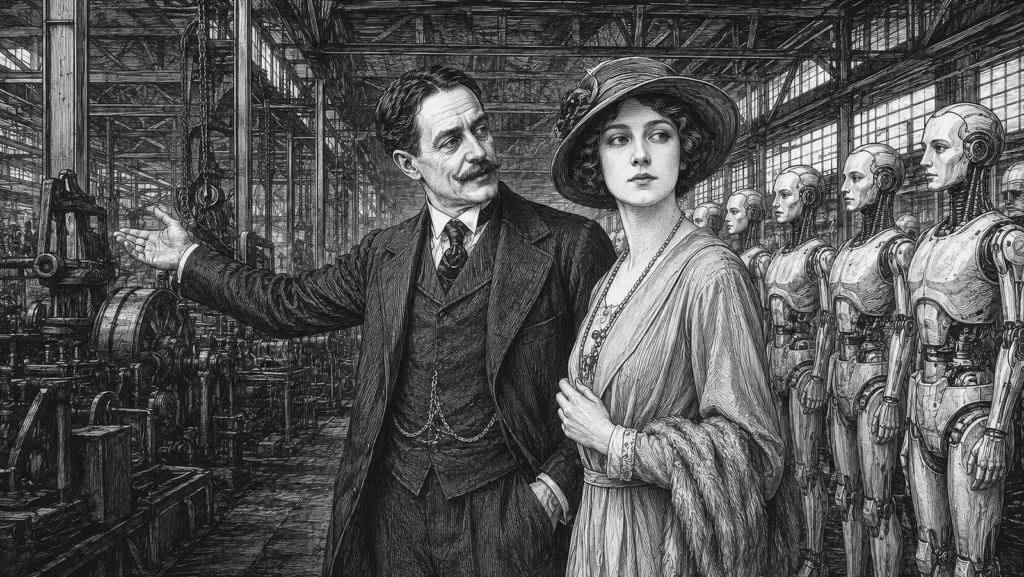
The robots of R.U.R. are not metal. There is no steel, no clanking, no rivets, nothing that looks like the machine men of later pulp covers. Old Rossum discovers a synthetic living matter; his son works out how to mass produce beings from it. What comes off the line is organic, indistinguishable from a person to look at, built without the parts a person does not strictly need in order to work. A modern reader has a better word for them than robot: they are closer to synthetic humans, and the line runs from them to every replicant and android since.
The play itself is stranger and sadder than its reputation. Helena Glory arrives at the island factory to campaign for the rights of beings that nobody believes can suffer. Domin, the director, shows her around a business at the height of its confidence. A scientist gives the robots the capacity to feel, out of something close to compassion, and that gift is the hinge on which everything turns. The rebellion, when it comes, is less a monster movie than a general strike that cannot be negotiated.
What is remembered least, and is the best of it, is the last act. Humanity is gone, except for one man, spared because he works with his hands. The stage empties out, the noise stops, and the play becomes a chamber piece about whether anything can begin again. Čapek does not end on catastrophe. He ends on something tentative and almost tender, which is not at all what a hundred years of second-hand summary would lead you to expect.
How a Czech play conquered the English language
The first performance was not the grand one. In January 1921 an amateur company staged R.U.R. in the provincial town of Hradec Králové, ahead of the National Theatre in Prague, which followed later the same month.
After that the play travelled with remarkable speed. New York saw it in 1922, staged by the Theatre Guild at the Garrick Theatre; London followed in 1923; Warsaw, Belgrade, Vienna, Berlin and Paris came in quick succession. Within a few years the text existed in more than thirty languages. The English version was made by Paul Selver and adapted for the London stage by Nigel Playfair, and it is that translation, the one that first carried the word into English-speaking theatres, that this edition preserves.
Somewhere in that decade the word slipped its moorings and stopped belonging to the play at all. By 1938, when the BBC broadcast an adaptation as one of the first pieces of science fiction ever shown on television, robot was simply an English word, and few of the people using it could have named its source. Čapek returned to the subject more than once, with a certain wryness, explaining what he had meant and what he had not.
Why it reads differently now
It is tempting to call R.U.R. prophetic, and the temptation is worth resisting, because it makes the play smaller than it is. Čapek was not forecasting hardware. He was writing about labour, which is why the play has aged so much better than the technology in it.
Its questions are labour questions, and they are being asked again in offices and warehouses and studios right now. What happens to a person when the work that defined them is taken over by something that does it cheaper and does not complain. What efficiency is for, once it has no limit. Whether a thing that works like us, and eventually feels like us, can go on being property. The play does not answer these questions so much as put them on a stage and let them run to their conclusion.
Čapek was a democrat with a clear view of interwar Europe and few illusions about where it was heading, and he wrote against what he saw coming with more courage than most. He was nominated for the Nobel Prize repeatedly. He died in December 1938, a few months after the Munich Agreement, before the state he loved was dismantled. Josef, who had found the word, died in Bergen-Belsen in 1945.
The word they made between them, in an afternoon, has outlived them both by a century and shows no sign of tiring.
Reading the play itself
Most people meet R.U.R. second hand, in a paragraph like the ones above. It is worth the two hours it takes to read properly, partly because so much of what everyone knows about it is wrong, and partly because the ending is genuinely worth arriving at.
Our edition of R.U.R. (Rossum’s Universal Robots) carries the classic Selver and Playfair translation, the one that gave the word to English. It sits alongside the rest of our Glagoslav Classics, the foundational works of the Slavic world and beyond.