The Literary Legacy of Armenian Chronicles – Bridging History, Myth & Philosophy
Introduction
Armenian chronicles are more than dusty historical records. They show a civilisation that grew at the crossroads of history, myth and philosophy. Born in the 5th century, after Mesrop Mashtots created the Armenian alphabet, these texts set down epic battles, royal dynasties, divine visions and philosophical questions. They bridge the recorded past and the world of imagination, preserving a people who, through centuries of exile and turmoil, held on to their cultural and spiritual roots.
From Movses Khorenatsi’s History of Armenia, a foundation of Armenian identity, to the accounts of the Vardanantz wars and the detailed records of the Cilician kingdom, these chronicles fuse fact with folklore, history with theology. They wrestle with questions of faith, justice and human destiny while staying anchored in the Armenian experience: its rugged landscapes, sacred language and stubborn spirit. They are not only relics of the past. They still shape national consciousness and say a great deal about the human condition, and they belong on the reading list of anyone interested in world literature and cultural heritage.
Historical Context
The Armenian chronicles emerged during the “Golden Age” of Armenian literature in the 5th century. The period began with the invention of the Armenian alphabet, which allowed monks, scholars and statesmen to record their history and defend their newly adopted Christian faith against pressure from neighbouring empires. Caught between the Persian Empire’s push for Zoroastrianism and Byzantine cultural dominance, Armenia faced threats to its existence, and the chronicles became both a shield and a voice for it.
By the 8th century, an intellectual revival produced theological treatises and royal biographies, adding new dimensions to the chronicle tradition. In the 13th and 14th centuries the Cilician Armenian kingdom, a maritime state, produced diplomatic chronicles recording its dealings with Crusaders, Mongols and Mediterranean powers. Each era of invasion, displacement or cultural flourishing left its mark, turning the chronicles into a layered record of endurance and adaptation.
What sets these works apart from ordinary medieval annals is their blend of moral reflection and mythic storytelling. They do not simply list kings and conquests. They frame Armenia’s struggles within a Christian narrative, tracing a sacred lineage from Noah’s Ark on Mount Ararat to visions of future redemption. That fusion of history and spirituality makes the chronicles a study of identity and survival that reaches well beyond their own time and place.
Major Armenian Chronicles
Movses Khorenatsi (History of Armenia)
Known as the “father of Armenian history,” Movses Khorenatsi wrote History of Armenia in the 5th century, blending Hellenistic philosophy, Biblical ancestry and ancient oral epics to chart Armenia’s origins from the legendary patriarch Hayk to the Sassanid conflicts of his own day. His rhythmic prose and his synthesis of myth and history set the standard for every Armenian chronicler who followed. Some modern scholars question his timeline and his sources, yet the chronicle remains a cultural monument, admired for its poetic beauty and for its long influence on Armenian historiography.
Vardanantz Narratives
The Vardanantz narratives record the wars of 449–454 CE, with the Battle of Avarair as their climax. Vardan Mamikonian led Armenian forces against the Sassanid campaign to impose Zoroastrianism, a struggle that ended in military defeat but was recast as a victory of faith. These chronicles turn Vardan’s martyrdom into a national symbol of resistance and present his sacrifice as a covenant that secured Armenia’s Christian identity against all odds, an act of defiance that has been retold ever since.
Cilician Chronicles
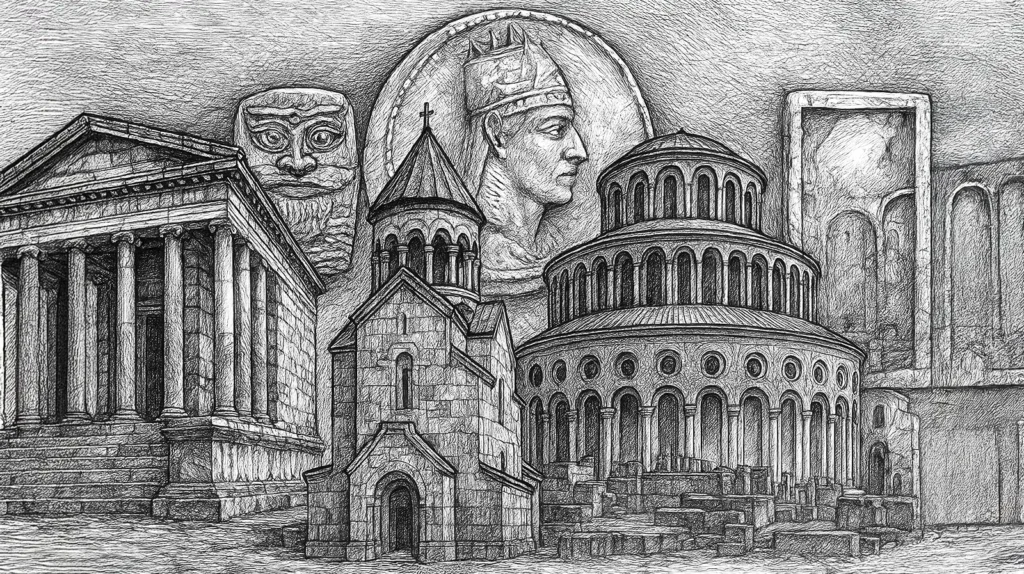
From the 13th-century Cilician Armenian kingdom, chroniclers such as King Het‘um II and Smbat Sparapet documented a society that prospered as a conduit between East and West. Their writings record treaties, busy ports and the minting of coins, a pragmatic counterpoint to the mythic tone of the earlier chronicles. The shift reflects Cilicia’s role as a diplomatic power dealing with Crusaders and Mongols, and shows how the chronicle genre changed to meet the demands of a changing world.
Agathangelos (The Conversion of Armenia)
Agathangelos’s 5th-century The Conversion of Armenia recounts the miraculous deeds of Gregory the Illuminator and King Trdat’s conversion to Christianity in 301 CE, which made Armenia the first Christian nation. The chronicle is more than a historical record. It is a national charter, binding church and state in a narrative that fixed Armenia’s spiritual identity. Its storytelling and its theology show how far faith shaped the Armenian mind.
Key Themes & Motifs
Identity, Exile & Homeland
Exile runs like a thread through the Armenian chronicles, and it appears not as tragedy but as a sacred journey. The idea of hayrenik’ (fatherland) binds Armenians together, whether in medieval Crimea or present-day Los Angeles, offering a homeland that exists in scripture, song and shared memory. Chroniclers fold displacement into a story of endurance, so that Armenia’s spirit carries beyond its physical borders.
Faith & Resistance
Faith in the chronicles is a call to action and a source of strength against oppressors. From the Vardanantz wars to reflections on the 20th-century Armenian Genocide, religious belief drives resistance, and martyrdom is presented as an assertion of agency. These stories turn suffering into proof of conviction and have kept later generations firm in their values.
Human Condition & Social Justice
Chroniclers such as Khachatur Abovian write about the marginalised: peasants, widows and orphans, using their stories to criticise feudal tyranny and colonial injustice. The texts are historical accounts and appeals for equality and dignity at once, linking the past to struggles that have not ended.
Nature & Mythic Geography
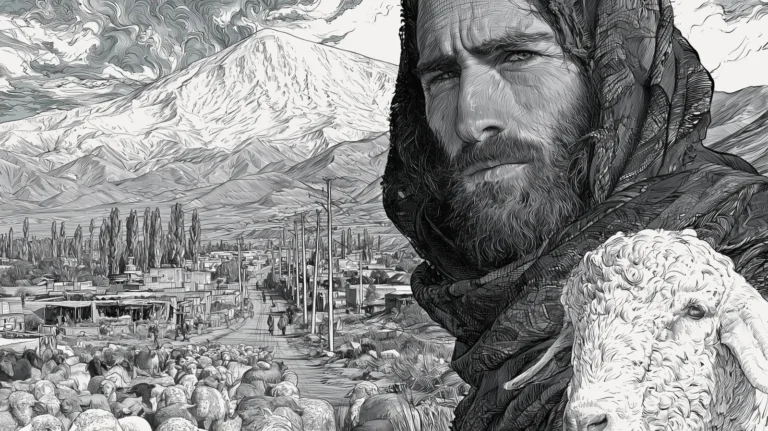
The Armenian countryside, Mount Ararat, apricot orchards and mountain springs, carries spiritual meaning throughout the chronicles. These places stand for divine harmony and for a human duty to protect it, with Ararat as a sign of hope and continuity in a turbulent history.
Literary Style & Technique
Armenian chronicles draw on a range of literary techniques:
- Hybrid Narrative – A close mix of history, epic poetry, saints’ lives and philosophical reflection, addressing the mind and the heart at once.
- Ring Composition – Cyclical storytelling that echoes themes of fall, exile, and redemption, reinforcing a sense of divine purpose.
- High Grabar Armenian – The classical language, mixed with Greek, Syriac and Persian influences, gives an elegant tone, later balanced by earthy vernacular in some works.
- Illuminated Manuscripts – Visuals such as miniatures of Noah’s Ark atop Ararat add symbolic artistry to the text, so that each manuscript is also an object to look at.
Together these elements make works of a distinct literary kind.
Impact on Armenian Identity
For a people often without a state, the chronicles became a “portable homeland,” carrying language, faith and culture through centuries of upheaval. They shaped church rituals and legal codes, and they influenced 19th-century reformers and modern diaspora educators. Their words have kept Armenian identity alive for a scattered nation.
Beyond the page, oral retellings at weddings, pilgrimage feasts and genocide memorials keep the old stories in use, turning them into rituals that connect communities across the world. That living tradition is why the chronicles still shape Armenian consciousness.
Modern Reception & Interpretation
Armenian chronicles are now attracting fresh study, with classicists, historians and Armenologists examining their origins and influences through methods such as carbon dating. Writers including Krikor Zohrab and Nancy Kricorian have reworked their themes, taking up gender, memory and trauma for contemporary readers.
Digital humanities projects and UNESCO programmes have carried these texts into the 21st century through online archives and translations that reach a global audience. The renewed attention has fed discussions of cultural resilience, human rights and environmental ethics.
Conclusion
Armenian chronicles combine history and myth, recording a nation’s triumphs and tragedies while offering lessons that have outlasted their authors. Their stories of faith, exile and perseverance still occupy scholars, artists and readers, and they show that words can preserve a culture against long odds. As Armenia and its diaspora face the future, the chronicles remain a point of reference for how a people defines itself.