
Chernobyl at 40: What We Still Get Wrong About the Worst Nuclear Disaster in History
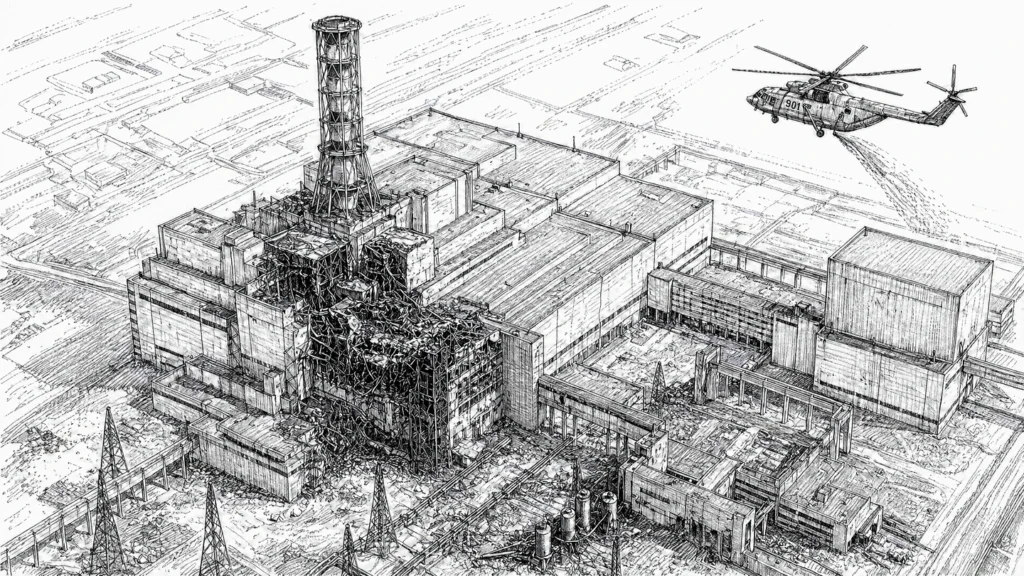
At 1:23 a.m. on April 26, 1986, a thermal explosion tore through Reactor No. 4 of the Chernobyl Nuclear Power Plant. The blast was not supposed to happen. Engineers on duty that night were running a safety test.
Forty years later, Chernobyl is everywhere again – retrospectives, documentaries, memorial ceremonies. Ukraine marks the anniversary under conditions that would have seemed unimaginable even a few years ago: an active war, Russian strikes on critical infrastructure, and occupation forces that briefly seized the exclusion zone itself in 2022.
The coverage is not wrong, exactly. But it tends to flatten things. Chernobyl gets treated as a sealed chapter – a tragedy that happened, was contained, and now belongs to history. The reality is harder to hold.
What actually happened that night
The explosion came during a test meant to simulate how the reactor would behave during a power outage. The safety systems had been partially disabled. When operators tried to shut the reactor down, a design flaw caused a surge in power instead of a drop. The core exploded. The graphite moderator caught fire.
The first people to arrive were firefighters from Pripyat and Chernobyl. They had no protective equipment beyond their standard gear. Nobody told them what they were walking into. Many received lethal radiation doses within hours. They kept working anyway.
By morning, the Soviet authorities knew the situation was catastrophic. They told almost no one.
The city of Pripyat – home to nearly 50,000 people, most of them plant workers and their families – saw no evacuation order until 36 hours after the explosion. Residents packed for three days. Nearly all of them never came back.
The radioactive plume moved northwest. It crossed Ukraine, Belarus, and into Scandinavia. Swedish nuclear workers arriving at their own plant on April 28th triggered radiation alarms – contamination on their shoes. That is how the outside world learned something had happened in the Soviet Union.
The numbers that don’t fit neatly into a headline
The 30-kilometer exclusion zone around the plant still exists. Inside it, the New Safe Confinement – a massive steel arch installed in 2016 – now covers the original sarcophagus built over the destroyed reactor. Engineers designed it to last 100 years. It is already showing damage from nearby shelling and requires repairs.
More than one million Ukrainian citizens hold classification as Chernobyl-affected – liquidators, evacuees, people who lived in contaminated zones. Many have legal rights to specialized medical support and social benefits. According to Ukrainian analysts, a significant portion of these commitments remain underfunded or simply unfulfilled.
Researchers are still finding elevated radionuclide levels in the placentas of Ukrainian women living in affected regions. Oncological rates in contaminated areas remain a subject of ongoing – and often contested – study.
Forty years later, the accounting is not finished.
What the consensus left out – and why one book still matters
The official story of Chernobyl’s health consequences has always been contested. International bodies – particularly the World Health Organization and the International Atomic Energy Agency – have maintained relatively conservative estimates of the disaster’s long-term mortality and morbidity.
Critics have argued for decades that institutional interests, not science, shape these figures. The WHO and the IAEA operate under a 1959 cooperation agreement that critics say has constrained the WHO’s ability to independently assess nuclear disasters. The WHO has disputed this interpretation. The debate has never been resolved.
Into this argument came Wladimir Tchertkoff, a documentary filmmaker for Swiss television who spent years in the contaminated territories of Ukraine, Belarus, and Russia. What he saw – and what the official narrative could not account for – became the basis for a book that remains one of the most thorough and unsettling investigations of Chernobyl’s aftermath ever published.
The Crime of Chernobyl: The Nuclear Gulag is not a comfortable read. Tchertkoff worked alongside his filmmaking partner Emanuela Andreoli across seven documentary films before distilling the evidence into this volume. The result is encyclopedic in its documentation – names, dates, medical records, institutional decisions – and unflinching in its conclusions.
The title borrows deliberately from Solzhenitsyn. Like The Gulag Archipelago, it operates by accumulation: individual testimonies, scientific data, and political decisions layered until a pattern becomes undeniable. Tchertkoff’s argument is that the human cost of Chernobyl – particularly from long-term, low-level radiation exposure across contaminated populations – was systematically minimized to protect the nuclear industry’s interests.
Whether one accepts that argument in full or not, the evidence Tchertkoff assembles is not easily dismissed. The book documents what happened to communities left in contaminated zones, to children born in the years following the disaster, to liquidators who received no compensation, to scientists whose research contradicted the official consensus and found their careers stalled as a result.
When the French edition came out in 2006, it contributed directly to the founding of the organisation IndependentWHO, which staged daily protests in Geneva demanding the WHO publish unconstrained findings on Chernobyl and, later, Fukushima.
Why this anniversary is different
Previous anniversaries of Chernobyl presented a specific challenge: keeping the disaster from fading into abstraction, ensuring the liquidators were not forgotten, pressing governments to honour their obligations to affected communities.
This anniversary carries an additional weight. The exclusion zone has served as a military corridor. The plant itself came under the control of forces that showed, in the early weeks of the 2022 invasion, a willingness to dig trenches in the Red Forest – one of the most contaminated areas on earth – apparently without informing their own troops of the risk.
The infrastructure problem
The protective structure covering the site is not permanent. Maintenance, funding, and international cooperation – all of these things the containment requires – cannot be taken for granted in the current situation.
Tchertkoff’s central observation – that Chernobyl’s consequences extend across hundreds of years, not decades, and across hundreds of thousands of square kilometers, not a 30-kilometer circle – reads differently when the site sits in an active conflict zone.
The liquidators
Anniversary coverage tends to get one thing right, at least in principle: the people who fought the disaster.
More than 600,000 people took part in the cleanup and containment of Chernobyl between 1986 and 1990. Working in shifts and rotating through to limit individual exposure, they built the sarcophagus, cleared contaminated debris by hand when robots failed in the radiation environment, and drained the water beneath the reactor to prevent a second explosion that some feared could have been more devastating than the first.
Many of them are sick. Many are dead. The causal link between their exposure and their health outcomes has been, like so much about Chernobyl, a subject of prolonged and often bitter dispute.
The Crime of Chernobyl documents their stories with the same rigor it applies to everything else. It is, among other things, a record that these people existed, what they did, and what it cost them.
Forty years
At 1:23 a.m. on a Saturday in late April, the explosion happened. By the time most people in Pripyat woke up, the reactor had been burning for hours. By the time most people in Europe knew anything had happened, it had been burning for more than two days.
Forty years later, the fire is out. Steel and concrete seal the reactor. The exclusion zone sits quiet, overgrown, and visited by tourists.
But the strontium-90 in the soil has a half-life of 29 years. Caesium-137: 30 years. The plutonium in parts of the most contaminated areas: 24,000 years.
Chernobyl is not history. It is a very long present.
For those who want to understand what that means – not the myth, not the symbol, but the documented reality of what happened and what was hidden – The Crime of Chernobyl: The Nuclear Gulag by Wladimir Tchertkoff is where to start. It is available through Glagoslav Publications.