Our Blog
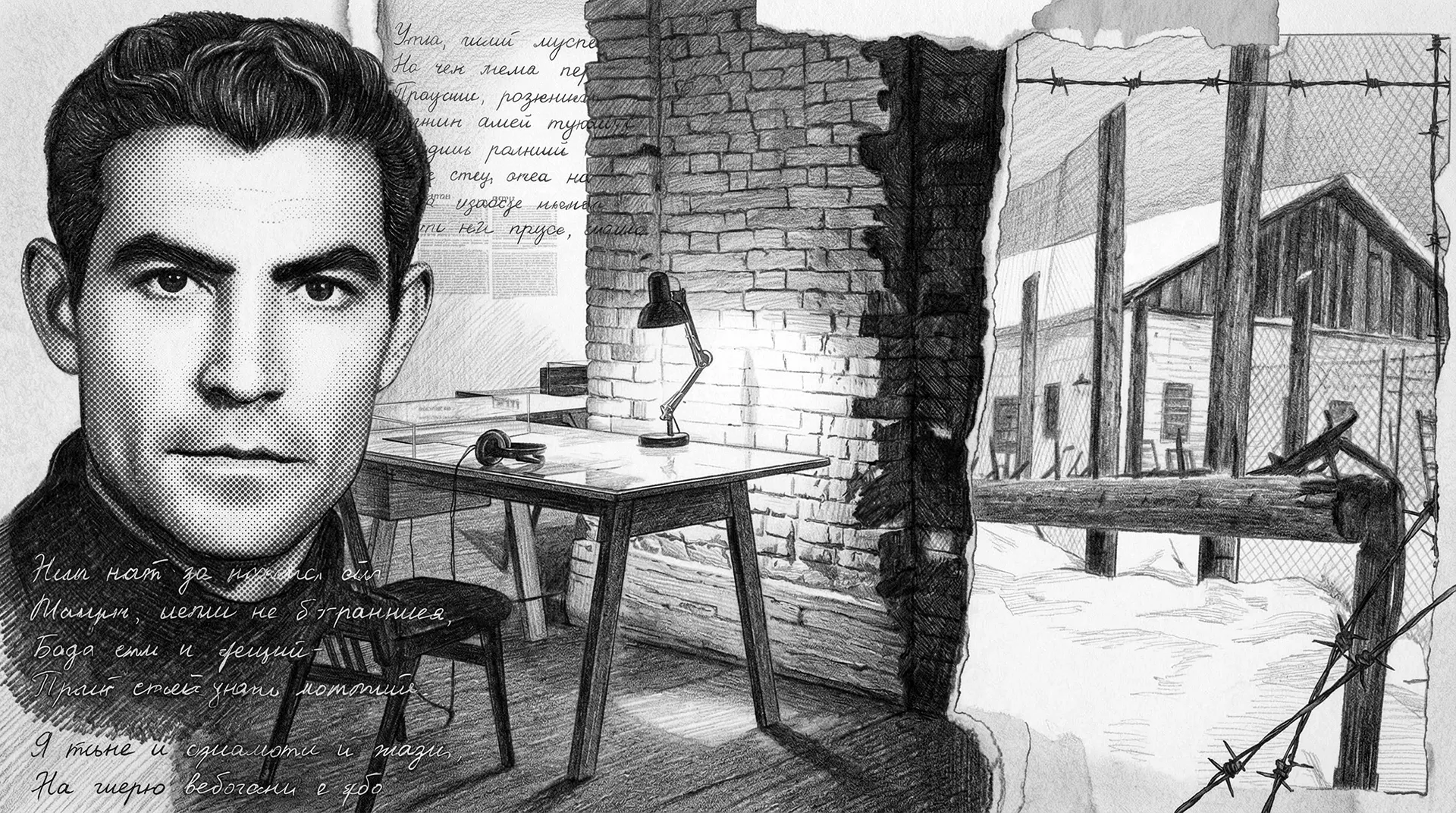
Vasyl Stus: Words Stronger Than Bars – Ukraine’s Poet of Resistance
Introduction
Some writers choose safety over sincerity. Vasyl Stus chose the opposite — and paid for it with decades of imprisonment and, ultimately, his life. A Ukrainian poet, literary critic, and political dissident, Stus stands as one of the most powerful voices to emerge from Soviet-era Ukraine: a man whose words, as the title of this article suggests, proved stronger than the bars meant to silence him.
Born in 1938 and raised in a Ukraine crushed under the weight of Stalinist repression, Stus came of age during a period when speaking Ukrainian in public could be treated as an act of political subversion. Yet rather than submit, he wrote — prolifically, beautifully, and without compromise. His poetry explored the tension between personal truth and state tyranny, between the imperishable human spirit and the machinery designed to break it. Today, he is recognised as a national hero of Ukraine and an enduring symbol of resistance for anyone who has faced the suppression of free expression.
This article traces the arc of Stus’s life and literary legacy — from his childhood roots in Ukrainian folk culture to his death in a Soviet labour camp — and explores why his work continues to resonate in Ukraine and beyond.
Background: A Poet Born Into Resistance
Vasyl Semenovych Stus was born on 8 January 1938 in Rakhivka, a village in the Vinnytsia region of Soviet Ukraine. He grew up during one of the most brutal chapters of Ukrainian history — the aftermath of the Holodomor, mass political repression, and the systematic erasure of Ukrainian cultural identity through Russification policies imposed by Moscow.
His earliest and most formative connection to Ukrainian identity came through language — specifically through his mother’s folk songs. These songs, passed down through generations, were not mere entertainment; they were vessels of cultural memory, keeping alive a national consciousness that the Soviet state sought to extinguish. The love for Ukrainian language and literature that Stus developed in childhood would become the defining axis of his adult life.
Stus studied Ukrainian philology at the Donetsk Pedagogical Institute and later pursued postgraduate work at the Institute of Literature of the Academy of Sciences of the Ukrainian SSR in Kyiv. It was in Kyiv during the 1960s that he became part of a remarkable generation of artists, intellectuals, and activists known as the shistdesiatnyky — “the Sixtiers” — who pushed back against Soviet cultural orthodoxy and reasserted the primacy of Ukrainian identity.
This was not a safe position to occupy. As the Soviet regime under Brezhnev intensified its crackdown on Ukrainian cultural dissent in the late 1960s, the members of this generation found themselves increasingly targeted. Stus, who had never been the kind of writer to hedge his convictions, was among the first to feel the full weight of state repression.
The Literary Voice of a Dissident
Stus’s literary career began in earnest in the early 1960s, and it was marked from the outset by an uncompromising commitment to artistic integrity. His early poetry engaged deeply with themes of national identity, the beauty and tragedy of the Ukrainian landscape, and the existential condition of the individual caught within the machinery of totalitarianism.
In 1965, Stus publicly protested the arrest of Ukrainian intellectuals during a film screening at the Kyiv cinema “Ukraine.” The protest cost him his postgraduate position, but it also confirmed his identity as a poet-activist for whom silence in the face of injustice was simply not an option.
His first major collection, Zymovi dereva (Winter Trees), was prepared in the mid-1960s but never officially published in the Soviet Union. The manuscript circulated in samvydav — the Ukrainian equivalent of Russian samizdat, the underground self-publishing networks through which dissidents shared forbidden literature. This mode of distribution was itself an act of defiance, creating a parallel literary culture invisible to — yet deeply threatening to — the state.
Stus’s poetry drew on a broad range of literary influences, from German Romanticism to the modernist traditions of Ukrainian writers like Mykola Zerov and Bohdan-Ihor Antonych. He read widely and thought deeply about what it meant to be a poet — not merely as an aesthetic category, but as a moral and existential vocation. To write was, for Stus, a form of bearing witness; to refuse to write was a form of complicity.
Creativity as an Act of Defiance
Central to Stus’s literary philosophy was a conviction about the nature and necessity of creativity itself. In his literary-critical essays and poetic texts, he articulated a vision of the poet as a figure navigating profound existential dilemmas — someone who understands that choosing poetry as a life path is not simply a professional decision, but an irreversible moral one.
This is not an abstract philosophical position. For Stus, writing poetry under Soviet conditions meant accepting the near-certain prospect of persecution. His reflections on the poet’s vocation emphasise what he called the “necessity” and “irreversibility” of the choice — the idea that a true poet cannot simply stop being a poet when the consequences become dangerous. To do so would be a betrayal not only of art, but of the self.
This understanding of creativity as something inseparable from personal identity and moral responsibility gives Stus’s work its distinctive intensity. His poetry is not the product of a writer who chose difficult themes for artistic effect; it is the expression of a man for whom difficult themes were simply the unavoidable content of lived experience.
The phrase “Words Stronger Than Bars” — which has become associated with Stus’s legacy — encapsulates this conviction. It speaks to a belief that the act of poetic creation is not defeated by imprisonment; if anything, it is distilled and intensified by it. The bars of a Soviet labour camp could confine the body but could not contain the act of naming, of bearing witness, of insisting on the truth of one’s own experience.
Artistic Techniques and Poetic Style
Stus was a poet of considerable technical sophistication. His work is characterised by condensed imagery, emotional intensity, and a rich metaphorical language that draws on both Ukrainian folk tradition and European literary modernism.
One of the most distinctive features of his poetry is the use of oxymoronic imagery — the deliberate juxtaposition of contradictory elements to create a tension that mirrors the paradoxes of his lived experience. In his poems, despair and hope coexist without resolution; beauty is found in desolation; freedom is imagined most vividly from within a cell. These oxymorons are not rhetorical tricks but structural expressions of a genuinely paradoxical reality.
Stus also employed rich spatial and sensory imagery to evoke the isolation and incompleteness of existence under repression. The Ukrainian landscape — its steppes, birch trees, and rivers — appears throughout his work not merely as background but as a living interlocutor, a presence that both witnesses and absorbs the poet’s grief and resistance. Nature in Stus’s poetry is never simply decorative; it is charged with historical memory and cultural meaning.
Literary critic Tamara Hundorova has coined the term “word-sacrifice” (slovo-zhertva) to describe the quality of Stus’s writing — the sense that each poem is offered up in full knowledge of the cost. This quality of total commitment, of writing as if the words might be the last you ever write, gives his poetry a gravity and urgency that has not diminished with time.
Imprisonment and the Price of Truth
Stus was arrested for the first time in 1972, as part of a broader wave of KGB repression targeting Ukrainian intellectuals. He was convicted on charges of “anti-Soviet agitation and propaganda” — a catch-all accusation that was routinely applied to anyone who wrote, spoke, or organised in ways the state found threatening. He was sentenced to five years in a labour camp followed by three years of internal exile in Magadan, Siberia.
Even in the camps, Stus continued to write. Poems were composed in secret, memorised, smuggled out, and added to the growing body of work that was circulating in samvydav and reaching readers in the Ukrainian diaspora in Western Europe and North America. The camps did not silence him; they gave his voice a new register — rawer, more stripped-down, but also more luminous.
Upon his release from the first term of imprisonment, Stus remained under close KGB surveillance and continued his dissident activities. In 1980, he was arrested again, this time receiving a harsher sentence: ten years of strict-regime camp followed by five years of exile. He was sent to the Perm-36 labour camp in the Ural region, one of the most brutal facilities in the Soviet camp system.
In 1985, as the world began to hear early murmurs of glasnost under Mikhail Gorbachev, Vasyl Stus died in the camp. He was 47 years old. The precise circumstances of his death remain a matter of historical dispute, but what is not in dispute is that he died a prisoner of a state that had never been able to make him stop writing.
In 1990, just before the Soviet Union’s collapse, Stus was posthumously rehabilitated. In 2005, the President of Ukraine awarded him the title of Hero of Ukraine.
Legacy and Posthumous Recognition
The posthumous reputation of Vasyl Stus has grown steadily since his rehabilitation, and his status in Ukrainian culture today is difficult to overstate. He occupies a place in the national literary canon comparable in some respects to that of Taras Shevchenko — a poet who suffered for his country’s freedom and whose suffering became inseparable from his art.
His reburial in Ukraine in 1990 was a major public event, drawing comparisons to the reburial of Shevchenko: an act of cultural restoration as much as of personal commemoration. The ceremony marked the beginning of a process of recovering a tradition that had been deliberately suppressed, and of reintegrating Stus’s voice into the mainstream of Ukrainian literary life.
The Vasyl Stus Prize, established in 1989, honours literary contributions that reflect his commitment to truth and artistic integrity. Annual ceremonies have taken on particular resonance in recent years, with speakers consistently drawing connections between the spirit of resistance embodied in Stus’s life and the ongoing struggle for Ukrainian sovereignty and cultural survival.
His work has also found new audiences through theatrical adaptations, beginning in the late 1980s and continuing to the present. These productions have contextualised his poetry within the broader narrative of Ukrainian identity and resistance against totalitarianism, introducing his voice to generations who did not live through the Soviet period.
The 2022 exhibition “As Long As We’re Here, Everything Will Be Fine”, held at Kyiv’s Mystetskyi Arsenal, further demonstrated the continued vitality of Stus’s legacy — and its direct relevance to a country once again fighting for its existence against Russian aggression.
Contemporary Resonance
It would be tempting to treat Vasyl Stus as a figure of purely historical significance — a martyr of the Soviet era whose relevance faded with the collapse of the system that killed him. But his continuing prominence in Ukrainian cultural and political life suggests otherwise.
Since Russia’s full-scale invasion of Ukraine in 2022, Stus’s poetry has circulated widely on social media, quoted by soldiers, artists, and ordinary citizens as an expression of defiance and endurance. The image of the poet who refused to be silenced by the most powerful repressive apparatus of the 20th century speaks directly to a present in which Ukrainians are once again being asked whether they will surrender their language, their identity, and their freedom.
His life also raises questions of urgent contemporary relevance about the relationship between art and politics, between the individual conscience and state power, and between cultural identity and national survival. These are not abstract questions in the context of Ukraine’s current experience — they are existential ones.
For scholars and readers outside Ukraine, Stus offers an entry point into a literary tradition of remarkable depth and resilience — one that has survived Tsarist suppression, Soviet repression, and now active military assault. His work, increasingly available in translation, invites readers to encounter Ukrainian poetry not as a curiosity or an act of solidarity, but as a body of literature with its own unique aesthetic achievements and its own profound things to say about the human condition.
Conclusion
Vasyl Stus chose his fate with open eyes. He understood the cost of writing truthfully in a system that demanded lies, and he chose to pay that cost rather than compromise the integrity of his art or his identity. In doing so, he created a body of poetry that has outlasted the empire that tried to silence it.
“Words Stronger Than Bars” is not just a tribute to one man’s courage. It is a statement about the nature of literature itself — about the capacity of language, when used with full commitment to truth, to resist, to endure, and ultimately to prevail. Stus believed that a poem could be a form of action as consequential as any political act. His life and death are the most compelling possible argument for that belief.
For publishers, readers, and writers committed to the literature of Eastern Europe, engaging with Stus’s work is not only an act of literary appreciation. It is a recognition that some voices are too important to remain on the margins of the world’s attention — and that the story of Ukrainian literature is one the world needs to hear.
Related articles
Latest articles
The World Caught Him, But It Could Not Hold Him: Hryhorii Skovoroda, Ukraine’s Wandering Philosophe
Read More »