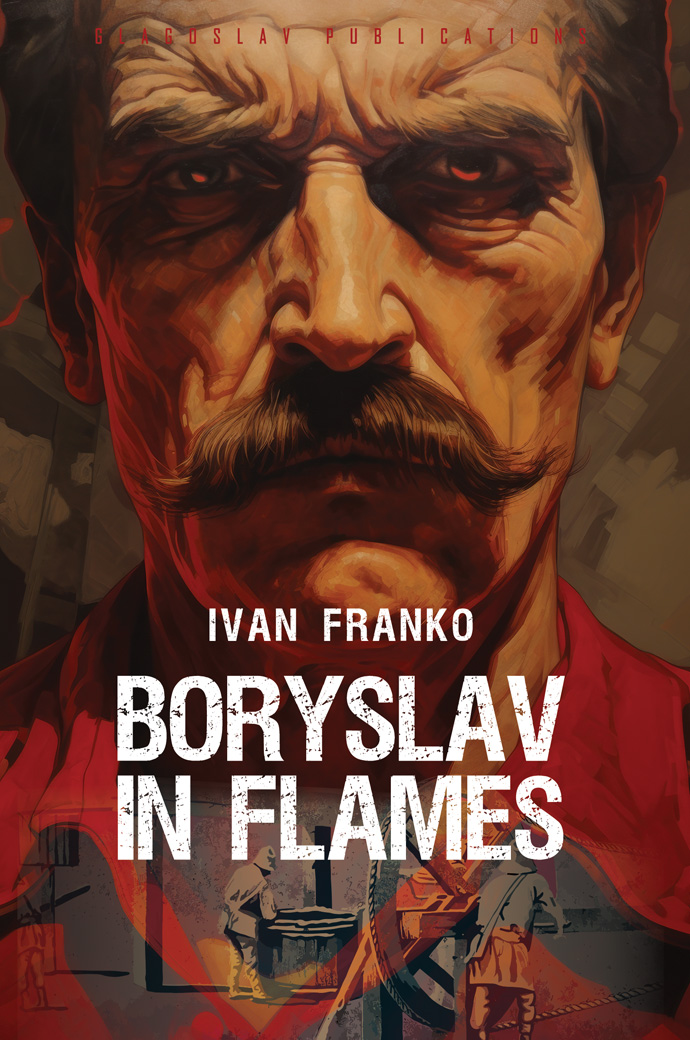
Boryslav in Flames
Price range: €9.95 through €28.99
Author: Ivan Franko
Translator: Yuri Tkacz
Boryslav in Flames by Ivan Franko is a pioneering novel that depicts the rise of the labour movement in Western Ukraine. The story unfolds against the backdrop of the industrial revolution in the Austro-Hungarian Empire during the 1860s.

Boryslav in Flames by Ivan Franko is a pioneering novel that depicts the rise of the labour movement in Western Ukraine. The story unfolds against the backdrop of the industrial revolution in the Austro-Hungarian Empire during the 1860s. As industry burgeons in Boryslav, a nascent working class emerges, inspired by socialist ideals – a unique phenomenon in mostly agrarian Galicia.
Central to the narrative is Benedio, a lowly mason’s assistant who organizes the striking workers. This is offset against the impulsive rebelliousness and violence purveyed by the Basarab brothers.
Woven throughout this tapestry of labour strife is a “Romeo and Juliet” subplot of romance between the offspring of two affluent oil tycoons.
Serialized in the Lviv magazine Svit from 1880 to 1881, the novella remained unfinished, due to the magazine’s closure. It was eventually published as a book in 1922.
Over time the novel has undergone evolving interpretations. Initially lauded as a portrayal of the budding labour movement, it was later dissected for its intricate character psychology and examination of wealth and power dynamics. Franko’s representation of the perspectives of the workers continues to provoke critical analysis, solidifying its status as a seminal work in Ukrainian literature.
This book has been published with the support of the Translate Ukraine Translation Program.
| Dimensions | 127 × 203 mm |
|---|---|
| Author | Ivan Franko |
| Pages | 322 pages |
| Publication date | 28th November 2023 |
| Book Format | Hardcover, Paperback, EPUB, Kindle |
Author
Ivan Franko
Ivan Franko (1856–1916) was a prominent Ukrainian poet, writer, journalist, and social activist. Born in a small village in Galicia, then part of the Austro-Hungarian Empire and now Ukraine, Franko emerged as a leading figure in Ukrainian literature and cultural revival during the late nineteenth and early twentieth centuries.
Franko’s literary career began with poetry, where he expressed his deep love for his homeland and its people. His works often touched on themes of social justice and the plight of the Ukrainian peasantry. He also contributed significantly to the development of modern Ukrainian literature, introducing innovative literary forms and styles.
Beyond his literary pursuits, Franko actively engaged in political and social activism, fighting for the recognition of the Ukrainian language, culture, and education. He co-founded and edited several Ukrainian newspapers and journals, using them as platforms to promote his ideas.
Franko’s contributions extended beyond literature and politics. He was an accomplished translator, bringing the works of many Western European authors to Ukrainian readers. Additionally, his plays and novels, such as Zakhar Berkut and “Stolen Happiness” remain staples of Ukrainian literature.
Translator
Born in Melbourne, Australia in 1954 and educated as an engineer, Yuri Tkacz left the profession to translate a broad range of works from Ukrainian by such authors as Kaczurowskyj, Honchar, Dimarov, Valeriy Shevchuk, Kariuk, Vynnychenko, Yanovsky and Antonenko-Davydovych. He lived and worked in Canada in the 1980s and in Ukraine in the 1990s. His translations of Hardly Ever Otherwise by Matios, Hard Times by Vyshnia, The Lawyer from Lychakiv Street by Kokotiukha and Precursor by Shevchuk have been published by Glagoslav Publications.
Endorsements and Review Quotes
It “is a quite exciting tale of fairness and injustice, and of the tension between the interests of workers and of capitalist-owners. […] All that Franko packs in does make Boryslav in Flames more entertaining than the usual ‘social’ novel but he really doesn’t need to have tried so hard; the best parts of the novel are when he focuses on the social issues, and especially the treatment of workers in these circumstances (with much wealth being created, while famine and other conditions force those without capital to seek work in these new industries).” M.A.Orthofer, the complete review
“Although unfinished, it is a well-plotted and well-paced novel, with vivid descriptions, authentic characterisation, if somewhat broad brush, but not lacking in subtlety and nuance.” Mandy Jenkinson, Historical Novel Society
Related products
-

Alpine Ballad
Price range: €9.95 through €26.99 Select options This product has multiple variants. The options may be chosen on the product page -
The Tale of Aypi
Price range: €9.95 through €25.85 Select options This product has multiple variants. The options may be chosen on the product page -

Leonardo’s Handwriting
Price range: €9.95 through €25.99 Select options This product has multiple variants. The options may be chosen on the product page -
Prisoner
Price range: €9.95 through €26.45 Select options This product has multiple variants. The options may be chosen on the product page -
A Poet and Bin-Laden
Price range: €9.95 through €27.25 Select options This product has multiple variants. The options may be chosen on the product page