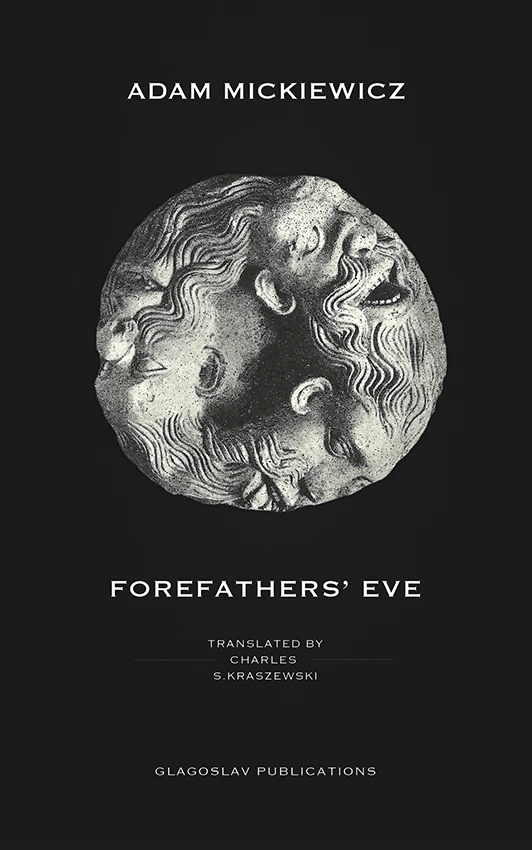
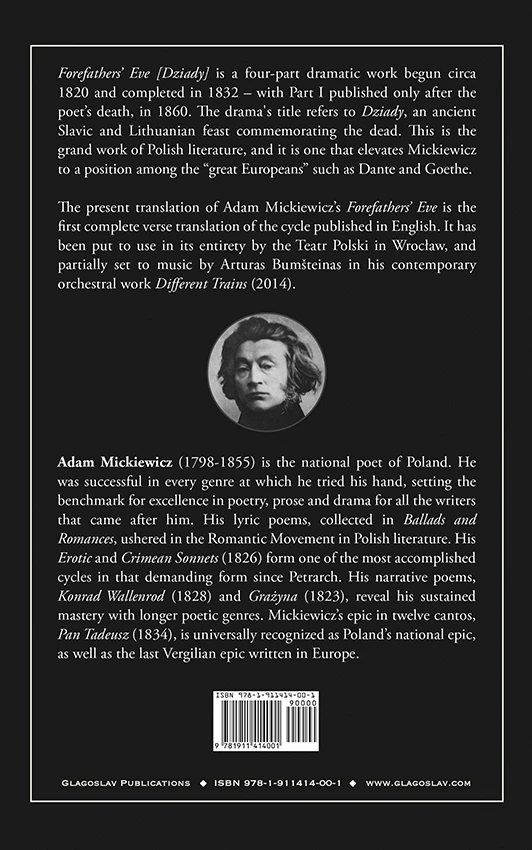
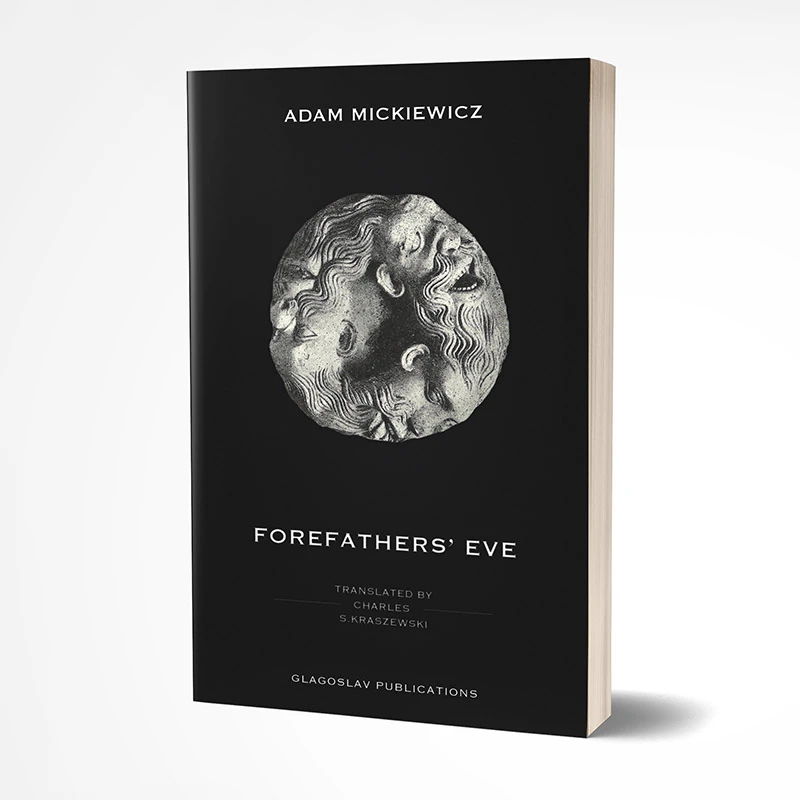
Forefathers’ Eve, in Polish Dziady, is the grand work of Polish literature and one of the summits of European Romanticism, a drama ranked by George Sand and Georg Brandes alongside Goethe’s Faust and Byron’s Manfred. This Glagoslav edition presents the first complete verse translation of the full four-part cycle into English, by the poet and translator Charles S. Kraszewski.
Its title names an ancient Slavic and Lithuanian feast for the dead, and the drama moves freely between the worlds of the living and the departed: revenant spirits, the communion of saints, love both earthly and transcendent, and a nation’s anguish under partition. Polish actors covet the central role of Gustaw-Konrad the way English actors covet Hamlet. The work founded Poland’s great tradition of Monumental Drama, running from Mickiewicz through Wyspiański to Kantor.
Kraszewski’s translation, with its extensive introduction, has been staged in full by the Teatr Polski in Wrocław. “A service to readers and teachers of Slavic literature in English,” wrote Boris Dralyuk in the Times Literary Supplement. Adam Mickiewicz (1798–1855) is the national poet of Poland; his lyric debut Ballads and Romances is also available from Glagoslav. An essential volume of Polish literature in translation.
This book was published with the support of the Hanna and Zdzislaw Broncel Charitable Trust.

Translator
Charles S. Kraszewski (b. 1962) is a poet and translator. He is the author of three volumes of original verse (Diet of Nails; Beast; Chanameed). Several of his translations of Polish and Czech literature have been published by Glagoslav, among which may be found: Adam Mickiewicz’s Forefathers’ Eve (2016) and Sonnets (2018), Zygmunt Krasiński’s Dramatic Works (2018) and Stanisław Wyspiański’s Acropolis: the Wawel Plays (2017). His translations of the poetry of T.S. Eliot, Robinson Jeffers, and Lawrence Ferlinghetti into Polish have appeared in the Wrocław monthly Odra. He is a member of the Union of Polish Writers Abroad (London) and of the Association of Polish Writers (Kraków).
Endorsements and Review Quotes
“<…> it is clear that Kraszewski’s translation is not only timely, but also a necessary part of the growing interest, in Poland and abroad, of realizing Mickiewicz’s monumental vision in fresh ways for a new, global audience.” John Merchant, Slavic Review
“Kraszewski manages to translate a text almost hermetically bound to its native culture, language, and history thus proving that the play is at least partially translatable. Thanks to his very detailed Introduction readers have not only a general description of the drama and its author, but also particulars of its both universal and national character, its significance in Polish and world literature.” Agata Brajerska-Mazur, The Polish Review
“The translation itself is fronted by the translator’s very insightful introduction, which explains to the English reader the historical circumstances and the literary significance of the Polish masterpiece.” Mieczysław Orski, Odra
“Forefathers’ Eve should be of great interest to those interested in Polish and Romantic literature, in Mickiewicz’s body of literary work, and in how one literary writer presents the Polish view of Russia and the Tsar in his times and what that historical tension between Poland and Russia may mean for the present.” Rev. Kevin Bezner, The Christian Review
“Kraszewski, who has been working on these plays for close to two decades, deserves high praise for his dedication, and his single-volume edition of the full cycle is a service to readers and teachers of Slavic literature in English.” Boris Dralyuk, The Times Literary Supplement
“Forefathers’ Eve by Adam Mickiewicz and translated by Charles S. Kraszewski is definitely a much-needed volume on your bookshelf.” Mary Lanham, Polish American Journal
“To keep up rhyme, or near-rhyme, for 300 pages of translation is a Herculean task: it sometimes causes Charles Kraszewski to add words or whole lines, use rare words or archaisms, laboured constructions or inexact rhymes that may disturb the ear and seem stylistically inconsistent. Or may pass unnoticed, since our reactions to such things are very personal.” Anita Jones-Debska, Pamiętnik Literacki