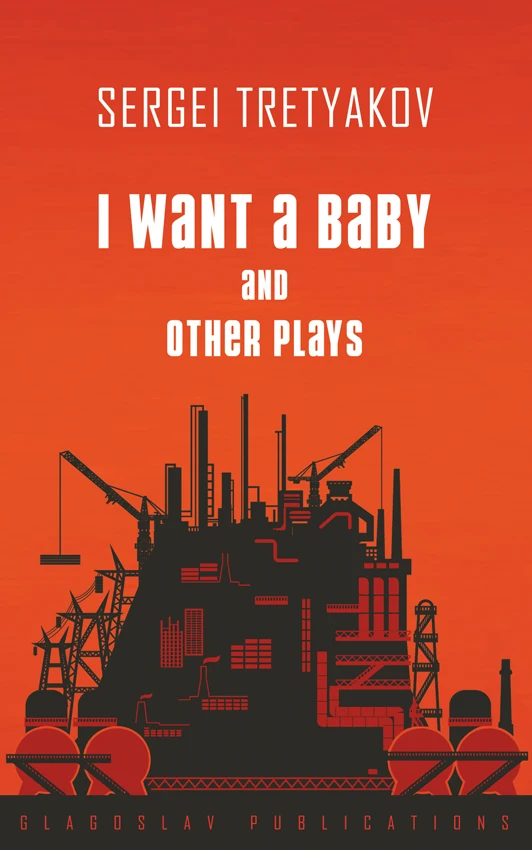
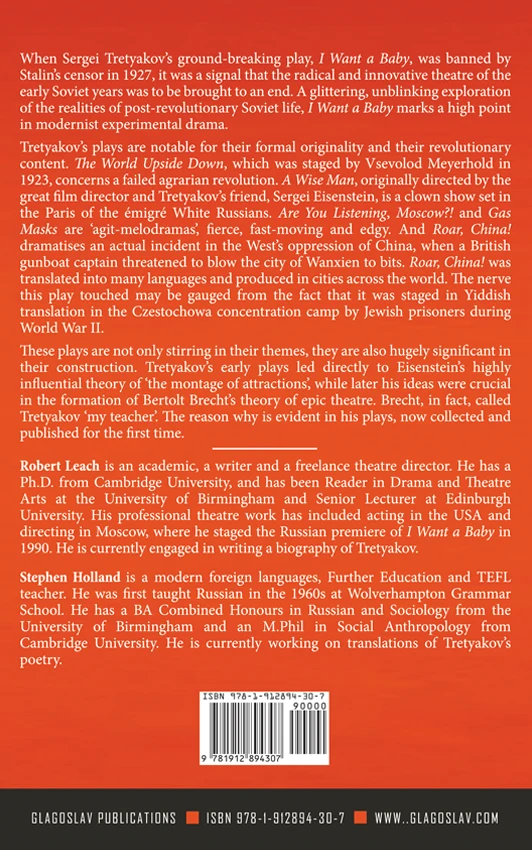
When Sergei Tretyakov’s ground-breaking play I Want a Baby was banned by Stalin’s censor in 1927, it was a signal that the radical theatre of the early Soviet years was to be brought to an end. Sergei Tretyakov’s plays, collected here in their entirety for the first time, mark a high point in modernist experimental drama.
Tretyakov’s plays are notable for their formal originality and their revolutionary content. The World Upside Down, which was staged by Vsevolod Meyerhold in 1923, concerns a failed agrarian revolution. A Wise Man, originally directed by the great film director and Tretyakov’s friend, Sergei Eisenstein, is a clown show set in the Paris of the émigré White Russians. Are You Listening, Moscow?! and Gas Masks are “agit-melodramas”, fierce, fast-moving and edgy. And Roar, China! dramatises an actual incident in the West’s oppression of China, when a British gunboat captain threatened to blow the city of Wanxien to bits. Roar, China! was translated into many languages and produced in cities across the world. The nerve this play touched may be gauged from the fact that it was staged in Yiddish translation in the Czestochowa concentration camp by Jewish prisoners during World War II.
These plays are not only stirring in their themes, they are also highly significant in their construction. Tretyakov’s early plays led directly to Eisenstein’s highly influential theory of “the montage of attractions”, while later his ideas were crucial in the formation of Bertolt Brecht’s theory of epic theatre. Brecht, in fact, called Tretyakov “my teacher”. The reason why is evident in his plays, now collected and published for the first time.
Translators
Stephen Holland is a modern foreign languages, Further Education and TEFL teacher. He was first taught Russian in the 1960s at Wolverhampton Grammar School. He has a BA Combined Honours in Russian and Sociology from the University of Birmingham and an M.Phil in Social Anthropology from Cambridge University. His postgraduate dissertation examined aspects of the Russian anthropologist S.I.Vainshtein’s work on the nomadic culture of Tuva, now renamed Tyva. He is currently working on translations of Tretyakov’s poetry.
Robert Leach is an academic, a writer and a freelance theatre director. He has a Ph.D. from Cambridge University, and has been Reader in Drama and Theatre Arts at the University of Birmingham and Senior Lecturer in the School of Languages, Literatures and Cultures at Edinburgh University. His professional theatre work has included acting in the USA and directing in Moscow, where he staged the Russian premiere of I Want a Baby in 1990.
He has written over a dozen books on the theatre, including Revolutionary Theatre (Routledge 1994) and Russian Futurist Theatre: Theory and Practice (Edinburgh University Press, 2018), and he co-edited with Victor Borovsky A History of Russian Theatre (Cambridge University Press, 1999). He is also a poet, and five collections of his poetry have been published. He has specialised in the work of Sergei Tretyakov, whose daughter, Tatyana Tretyakova, he worked with. His biography of Sergei Tretyakov, A Revolutionary Writer in Stalin’s Russia, is also available from Glagoslav.
Endorsements and Review Quotes
“Tretyakov has one of the most colorful biographies in the crowded field of early twentieth-century Russian letters. Yet while his name is well known to Soviet avant-garde aficionados, more people have read about Tretyakov than actually read him. […T]he translators have done a superb job of bringing these major but underappreciated plays to an Anglophone readership, filling a significant gap in translations of modernist theater. For this, Leach and Holland are owed a debt of gratitude by general readers, academic specialists, and ambitious directors alike.” Dominick Lawton, Delos
“Anyone who doesn’t know Tretyakov or who has been tempted to dismiss him as one of the many secondrate peddlers of agitprop should read, and if possible see, the work of this brave, funny and complex writer who, in the words of the poet Vadim Shershenevich, ‘was not afraid to go to the limits’.” Kate Pursglove, East-West Review
“This collection, expertly translated by Robert Leach and Stephen Holland, and brilliantly introduced by Leach, is a worthy tribute to a significant artist and will accelerate awareness.” James Heyworth-Dunne, the SCRSS Digest
“One cannot help wonder what the reception was like at its premiere in Shanghai in 1933 by the Shanghai Art Theatre Society which reportedly used on-stage cannons aimed at the audience […] But it remains powerful: it is propaganda, but the events it portrays actually happened.” Peter Gordon on Tretyakov’s play “Roar, China!”, Asian Review of Books
“Tretiakov was one of the most innovative and exciting playwrights and thinkers of the Soviet Union in the 1920s. I doubt that we would describe his work as feminist or even proto-feminist today, but he definitely had fascinating ideas about rethinking gender roles.” Olga Zilberbourg, Punctured Lines
“Even as other figures from his time have been revived in the public imagination, though, Tretyakov’s legacy has, up to now, been obscure. […] Alongside Stephen Holland, with whom he has shared the translating duties, Leach deserves our thanks for making these daring and unconventional plays available again. Over eighty years after his life, like the lives and careers of many of the most imaginative members of Russia’s creative intelligentsia, was cut short by a state that could find no place for him this collection gives Sergei Tretyakov the attention that his work, and not just his list of friends and collaborators, deserves.” Peter Lowe, Russian Art and Culture
“[T]his collection of Tretyakov’s plays portray his most daring artistic experiments, some of which were the most theatrical and exciting of the Early Soviet era.” Nathan Rtishchev, The Jordan Center for the Advanced Study of Russia