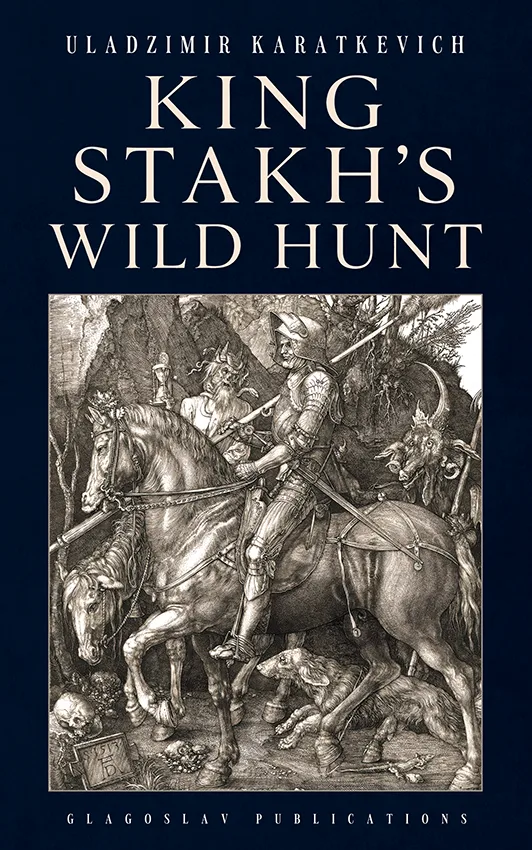
King Stakh’s Wild Hunt is the masterpiece of Uladzimir Karatkevich (1930–1984), the writer who created the Belarusian historical novel, and one of the great gothic tales of Slavic literature. First published in 1964 and adapted for film in 1979, it appears here in English translation by Mary Mintz.
On a rainy autumn night in 1888, the young folklorist Andrey Belaretsky loses his way on the marshes and finds shelter in Marsh Firs, the crumbling castle of the Yanovsky family. Its last descendant, the young Nadzeya Yanovsky, lives in terror of a two-hundred-year-old curse: ghostly riders, King Stakh’s Wild Hunt, who appear on the moors and bring death to her line. As Belaretsky begins to untangle the family’s secrets, the Hunt turns its attention to him, and what began as folklore becomes a matter of survival.
Readers have compared the novel’s fog-bound marshes to the Grimpen Mire of The Hound of the Baskervilles, and its brooding castle to the best of the gothic tradition. “The experiments in narrative fiction and the heightened sense of gothic drama seem perfectly accessible to a Western audience,” wrote Imran Khan in PopMatters. A jewel of Belarusian literature in English translation: a ghost story, a detective story, and a portrait of a nation’s soul.
Endorsements and Review Quotes
“King Stakh’s Wild Hunt is at once a story so contained within its own history, it threatens to alienate any reader outside of its cultural design. And yet, the experiments in narrative fiction and the heightened sense of gothic drama seem perfectly accessible to a Western audience brought up on the brooding belletristic tragedies of Greek myth.” Imran Khan, PopMatters
On the romantic landscaping of Socialist Belarus and Uladzimir Karatkevich: Elena Gapova, Rethinking Marxism
“Uladzimir Karatkievic’s output has a significant role as a ‘guardian’ of the collective memory of Belarusians today. As an author of historical novels he acted as both a researcher and archivist of Belarusians’ history. Perhaps thus Karatkievic’s King Stakh’s Wild Hunt is book about the past and present. It proves his genius as an author and sensitivity as a”commentator on the Belarusian nation.” Paula Borowska, The Journal of Belarusian Studies
“I enjoyed the writing and the atmosphere.” Jean, Howling Frog Books
“I was also reminded of the moor scenes in Hound of the Baskervilles sometimes the places in this book at to the scary feeling of Hope the marshes near the castle reminded me of the Grimpen mire of Hound of the Baskervilles. I love that Glagoslav can publish writers like Karatkevich to us in English.” Stu Allen, Winstonsdad’s Blog
in Belarusian media:
King Stakh’s Wild Hunt by Uladzimir Karatkevich in English/ THE POINT JOURNAL
Camilla Stein’s interview for Radio Liberty (In Belarusian)/RADIO LIBERTY
NASHA NIVA

 Uladzimir Karatkevich (1930-1984) was a Belarusian writer, poet, playwright, journalist and screenwriter, known as the creator of the Belarusian historical novel.