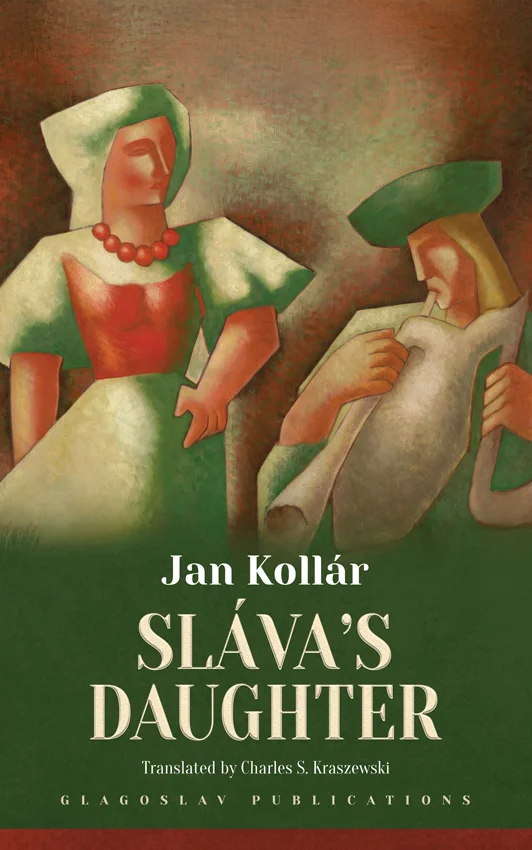
Sláva’s Daughter
Price range: €14.99 through €35.99
Author: Jan Kollár
Translator: Charles S. Kraszewski
An epic cycle of 645 sonnets celebrating the unity and destiny of the Slavic world. In Sláva’s Daughter, Romantic poet Jan Kollár blends love, mythology, and Pan-Slavic vision in one of the great poetic monuments of the 19th century.

‘O fair Slavenka! / You sing no more’, laments the twenty-four year old Jan Kollár, wandering the ancient forests of eastern Germany where Slavic tribes once lived, ‘Where once the marble walls / of Perun’s palace rose on high, the posts / — O, shameful mockery! — now prop a byre’. Born in Mošovce, in the Turiec region of what at the time was the Kingdom of Hungary, the Slovak Kollár (1793–1852), was to become one of the most interesting and significant poets of the Romantic period, and turn his lament into Sláva’s Daughter [Slávy dcera, 1821–1851] an epic striking both in its breadth, and intent. For although composed during the Czech and Slovak national revival period, the ‘nation’ that Kollár laments, praises, and serves in his masterpiece is ‘Slavdom’.
Sláva’s Daughter is unique in its unrelentingly aspirational Pan-Slavism. At a time of increasing Germanisation and Magyarisation in multi-ethnic empires such as Habsburg Austria-Hungary, the Czech and Slovak subjects of Vienna and Budapest began more forcefully to assert their ethnic identities. Their renewed, and active, interest in their native tongues and traditions led to a blossoming of Czech and Slovak culture known as the national revival. Kollár, however, was of the opinion that Czechs, Slovaks, Ukrainians, Poles, Croatians, Russians, and all the rest were merely ‘tribes’ of the one Slavic nation, and their languages ‘dialects’ of one great Slavic speech.
A Pan-Slav, he worked for ever greater cultural reciprocity between the ‘sons of Sláva’, which hopefully would lead to their political unity: ‘What will be with the Slavs a century /from now?’ he muses toward the end of Canto III, foretelling a great future before the united Slavic nation, taking their rightful position on the world stage. As ideology, Sláva’s Daughter is sweeping in scope. In encyclopaedic fashion, it recounts the history, both glorious and fatal, of all the Slavic nations since the early middle ages, and calls the contemporary Slavs to rise from their knees and work together for the splendid future that awaits those faithful to their ‘mother’ Sláva.
As poetry, Kollár’s masterpiece is a bold and singular work of literature, which combines the style of Petrarch’s Il Canzoniere with the prophetic grandeur of Dante Alighieri’s Divine Comedy, as its story develops over the space of 645 sonnets arranged into five peripatetic cantos. Along with Kollár’s narrator, we follow his donna ideale Mína, and Milek, the Slavic Cupid, as they lead us along the banks of Slavic rivers (Elbe, Vltava, Danube), and those of Slavic Heaven and Hell (Lethe, Acheron) towards the great dawn of Pan-Slavic triumph. Sláva’s Daughter, which Glagoslav presents unabridged and annotated in the English translation of Charles S. Kraszewski, is a must read for all those interested in the poetry and history of the European nineteenth century.
This book was published with a financial support from SLOLIA, Centre for Information on Literature in Bratislava.
| Dimensions | 152 × 229 mm |
|---|---|
| Author | Jan Kollár |
| Pages | 640 pages |
| Book Format | Hardcover, Paperback, EPUB, Kindle |
| Publication date | 13th March 2026 |
Author
Jan Kollár
Jan Kollár (1793–1852), Lutheran pastor and poet, Kollár is one of the most important poets of the Romantic Period in Central Europe. Born in Slovakia, a tireless defender of the rights of Slovaks, Croats, and other peoples in the Hungarian Kingdom subject to increasing Magyarisation, Kollár was nonetheless a Pan-Slav. In his view, all Slavs — Poles, Czechs, Russians, etc. — are not separate nations, but ‘tribes’ of one great Slavic nation. His greatest work of poetry is Slávy dcera (1821 – 1852), which proclaims his ideal of the cultural and political integration of the Slavic peoples of Europe. In five Cantos named after rivers both real and mythological, Sláva’s Daughter combines both the style of Petrarch’s Il Canzionere with the epic breadth and motivation of Dante’s Divine Comedy.
Translator
Charles S. Kraszewski (born 1962) is a poet and translator, creative in both English and Polish. He is the author of three volumes of original verse in English (Diet of Nails; Beast; Chanameed), and two in Polish (Hallo, Sztokholm; Skowycik). He has also authored two satirical novels Accomplices, You Ask? and At the Tone (both San Francisco: Montag, 2021, 2024). He translates from Polish, Czech and Slovak. He is a member of the Union of Polish Writers Abroad (London) and the Association of Polish Writers (SPP, Kraków). In 2022, he was awarded the Gloria Artis medal (III Class) by the Ministry of Culture of the Republic of Poland, and in 2023 the ZAiKS award for Translation into a Foreign Tongue, presented by the Polish Society of Authors (ZAiKS).
Endorsements and Review Quotes
Sláva’s Daughter stands among the most ambitious poetic works of Slavic Romanticism. In this sweeping cycle, Jan Kollár transforms lyric love poetry into a visionary meditation on the unity of the Slavic world. The translation by Charles S. Kraszewski captures both the philosophical depth and musical elegance of Kollár’s verse, making this monumental work accessible to modern English readers.
Related products
-
Maybe We’re Leaving
Price range: €9.95 through €24.49 Select options This product has multiple variants. The options may be chosen on the product page -
Dramatic Works
Price range: €9.95 through €27.80 Select options This product has multiple variants. The options may be chosen on the product page -
A Brown Man in Russia: Lessons Learned on the Trans-Siberian
Price range: €9.95 through €24.50 Select options This product has multiple variants. The options may be chosen on the product page -
Jesus’ Cat
Price range: €9.95 through €22.99 Select options This product has multiple variants. The options may be chosen on the product page -
Combustions
Price range: €9.95 through €23.99 Select options This product has multiple variants. The options may be chosen on the product page