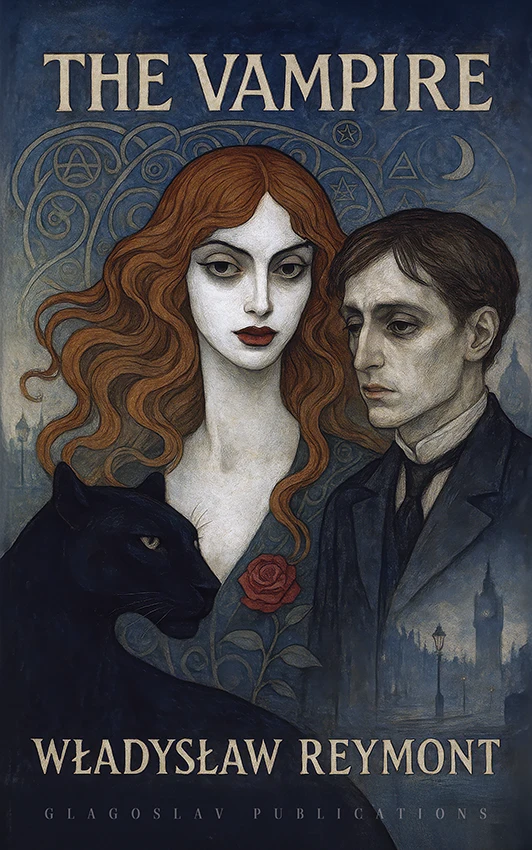
The Vampire
Price range: €9.95 through €27.99
Author: Władysław Reymont
Translator: Filip Mazurczak
Zenon (inspired by Joseph Conrad, perhaps?) is a successful Polish émigré novelist living in perpetually foggy, late nineteenth-century London. A skeptic by nature, he watches his circle of friends succumb to the temptation of Spiritualism.
Zenon (inspired by Joseph Conrad, perhaps?) is a successful Polish émigré novelist living in perpetually foggy, late nineteenth-century London. A skeptic by nature, he watches his circle of friends succumb to the temptation of Spiritualism. While Zenon thinks their séances to be nothing more than suggestive smoke and mirrors, he cannot help but be drawn to the enigmatic, demonic femme fatale Daisy, whose capacity to bend the laws of physics challenges his tenacious rationalist worldview. Betsy, his somewhat naïve but unwaveringly faithful fiancée, won’t let the ominous Daisy snatch him from her wholesome embrace without a fight. To complicate matters, Ada, an old flame from Poland, has just arrived in England to reveal a shocking secret. Zenon won’t pass up this opportunity for closure…
Originally published in 1911 and available in English for the first time, The Vampire is not only one of the earliest works of horror in Polish literature. It is also a love story, a timeless and moving account of immigrant nostalgia, and above all a memorable time capsule of fin de siècle Spiritualist London, where séances were all the rage, Europeans were discovering Far Eastern mysticism, and Madame Blavatsky and Aleister Crowley were celebrities.

| Dimensions | 152 × 229 mm |
|---|---|
| Author | Władysław Reymont |
| Pages | 278 pages |
| Book Format | Hardcover, Paperback, EPUB, Kindle |
| Publication date | 17th March 2026 |
Author
Władysław Reymont
Translator
Filip Mazurczak is a Polish-American historian, translator, and journalist. His writing has appeared in First Things, Polin: Studies in Polish Jewry, Notes from Poland, and many others.
Endorsements and Review Quotes
…
Related products
-

The Hemingway Game
Price range: €9.95 through €25.50 Select options This product has multiple variants. The options may be chosen on the product page -
The Revenge of the Foxes
Price range: €9.95 through €23.99 Select options This product has multiple variants. The options may be chosen on the product page -

Moscow in the 1930s: A Novel from the Archives
Price range: €9.95 through €29.15 Select options This product has multiple variants. The options may be chosen on the product page -
The Investigator
Price range: €9.95 through €26.99 Select options This product has multiple variants. The options may be chosen on the product page -
The Nuremberg Trials
Price range: €9.95 through €26.80 Select options This product has multiple variants. The options may be chosen on the product page