Table of Contents
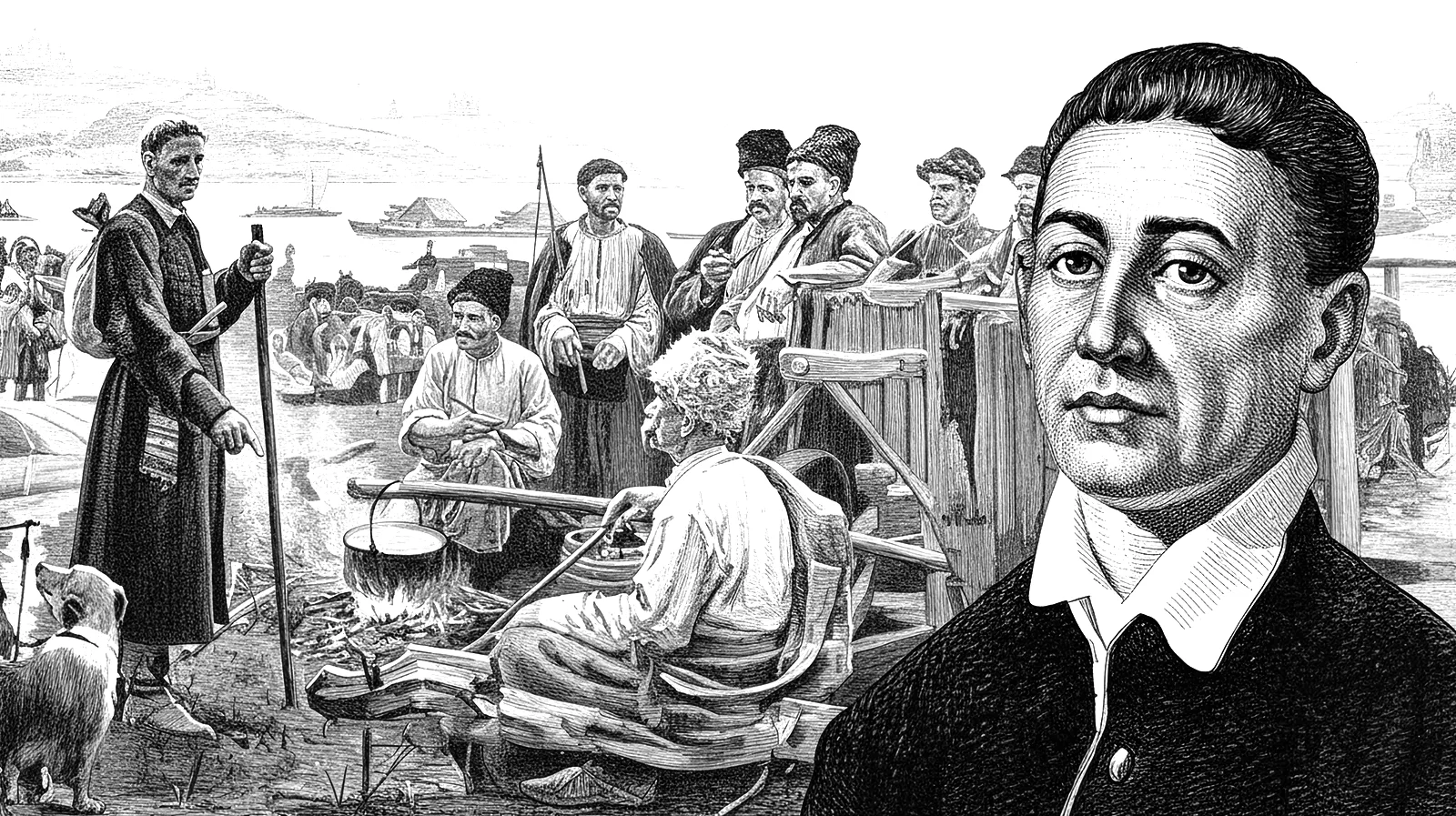
Long before the age of self-help gurus, a man roamed the roads of Ukraine with little more than a bag, a flute, and a radical philosophy. Hryhorii Skovoroda (1722-1794) was a thinker so far ahead of his time that he remains a cultural icon today. Often called Ukraine’s “wandering philosopher,” he was a poet, teacher, and composer whose life and work were dedicated to one profound idea: that the key to happiness lies not in the world outside, but within ourselves.
A Life of Learning and Wandering
Born in the village of Chornukhy near Kharkiv, Hryhorii Skovoroda’s journey began at the prestigious Kyiv-Mohyla Academy. This institution was a crucible of ideas where he immersed himself in philosophy and the works of contemporary thinkers. However, Skovoroda was never one to be confined by institutions. His academic life was marked by a revolutionary fervor and an unyielding quest for moral and spiritual truth.
True to his title, he spent much of his life as an itinerant teacher and thinker, walking from village to village and sharing his insights through poems, fables, and sermons. He rejected worldly possessions and prestigious positions, believing that a person’s life was simply the sum of their actions. For Skovoroda, to “know yourself” was the ultimate calling, a wisdom he shared with the ancient philosopher Socrates.
The Heart of Happiness: Skovoroda’s Core Philosophy
At the center of Skovoroda’s philosophy is the pursuit of inner peace through self-knowledge. He famously argued that happiness is not tied to “place, time, flesh, and blood,” but is a state of the soul found within. He championed the idea of “related work”—the belief that true success and fulfillment come from aligning one’s work with their natural talents and passions. As he put it, “if he does work without putting his heart into it, he will never be a success”.
Skovoroda was a sharp critic of materialism, arguing that the endless chase for wealth and status was a path to dissatisfaction. Instead, he taught that true peace comes from living in harmony with nature and engaging in constant self-reflection. For him, both heaven and hell were not external places, but states that exist within every individual.
The Garden of Divine Songs: A New Poetic Form
Skovoroda was not just a philosopher but also a groundbreaking poet who merged deep philosophical inquiry with artistic expression. His most famous collection, “Garden of Divine Songs,” is a masterclass in literary innovation from the Ukrainian Baroque period. In it, he broke free from rigid structures, using a wide variety of meters and stanza forms. Each of the thirty poems in the collection has a unique rhythmic pattern, serving as both a philosophical text and a practical guide to the art of poetry.
His writings often explore the moral crossroads every person faces: a choice between a path of evil that leads to misery and a challenging path of goodness that offers spiritual joy. This blend of folk traditions and academic forms enriched Ukrainian literature and cemented his role as a foundational figure in the nation’s prose-poetics.
The Enduring Wisdom of a National Icon
Skovoroda’s influence echoes powerfully through the centuries. His ideas resonated with later literary giants like Taras Shevchenko and Ivan Franko and continue to inspire contemporary Ukrainian authors such as Serhiy Zhadan and Oksana Zabuzhko. He is a pivotal figure whose work embodies the complexities of Ukrainian Baroque culture and the nation’s search for identity.
In a world still grappling with materialism and the quest for meaning, Skovoroda’s insights feel more relevant than ever. His life and teachings are a powerful reminder that the most profound journey is the one inward, and that true freedom is found not in what you have, but in understanding who you are. His legacy confirms his status as a cultural icon whose reflections continue to shape the Ukrainian identity.