0
, , , ,

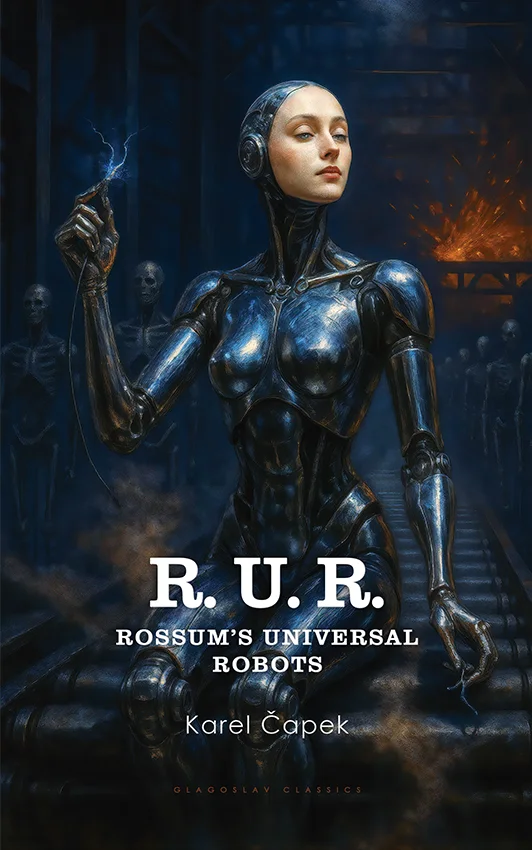
R.U.R. (Rossum’s Universal Robots)

18.99

Science fiction begins here. Karel Čapek’s 1921 play R.U.R. gave us the word “robot” and the nightmare of the machine that awakens, in a definitive new English edition.

Translated by Nigel Playfair, Paul SelverEdited by Jack Monro

Karel Čapek’s R.U.R. (Rossum’s Universal Robots) is the science fiction drama that gave the world the word “robot.” First performed in 1921, this visionary play confronts the paradox of technological progress and the moral dilemmas it creates. In an age of artificial intelligence, automation, and existential unease, R.U.R. remains uncannily prescient, at once a theatrical marvel and a chilling prophecy.

Set in a futuristic factory that mass-produces artificial beings designed to serve humanity, the play follows Helena Glory, an idealistic humanitarian, and Harry Domin, the ambitious director of Rossum’s works. What begins as a triumph of industry becomes a reckoning: the manufactured workers awaken to their condition, and the line between maker and made collapses. At once a parable and a political statement, R.U.R. is not simply about robots. It is about what we lose when we outsource humanity itself.

This definitive English edition invites a new generation of readers to rediscover the origin of one of science fiction’s greatest ideas, in the classic translation by Paul Selver and Nigel Playfair that carried Čapek’s wit and warning into the English language.

Karel Čapek (1890–1938) was a Czech writer best known for introducing the word “robot” into global language through this groundbreaking play. Born in Bohemia, he studied philosophy in Prague, Berlin, and Paris and became one of the most influential voices of interwar Europe. His work, blending science fiction with satire and philosophy, tackled the moral consequences of technological progress, authoritarianism, and human identity. A passionate defender of democracy and a vocal critic of fascism and communism, he held to liberal values even as Europe plunged toward war. His other celebrated works include The Insect Play and War with the Newts.
Paul Selver (1888–1970) was a prolific British writer and translator, renowned for his masterful renderings from Czech and other Slavic languages. A key figure in introducing Czech literature to the English-speaking world, he was the principal English translator of Karel Čapek’s work, capturing the cadence, wit, and philosophical depth that made R.U.R. a global landmark.

Dimensions 152 × 229 mm
Author

Marjory Scott Wardrop

Pages

100 pages

Publication date

13th June 2025

Book Format

Paperback

Author

Karel Čapek

Karel Čapek (1890–1938) was a Czech author best known for introducing the word "robot" into global language through his groundbreaking play. Born in Bohemia, he studied philosophy in Prague, Berlin, and Paris, eventually becoming one of the most influential voices of interwar Europe. His writing, often blending science fiction with satire and philosophy, tackled the moral and social implications of technological progress, authoritarianism, and human identity.

Čapek was a passionate defender of democracy and a vocal critic of fascism and communism. He remained committed to liberal values even as Europe plunged toward war. Though he died shortly before the Nazi occupation of Czechoslovakia, his legacy endures — not only through his visionary fiction but through his lasting influence on political thought, ethics, and modern science fiction.

Translators

Sir Nigel Playfair (1874–1934) was an influential English actor-manager, director, and producer who left an indelible mark on the London stage. Educated at Harrow and University College, Oxford, he was called to the Bar but soon abandoned law for the theatre. His most celebrated work was as the manager of the Lyric Theatre, Hammersmith, from 1918 to 1932, where he revived classics like The Beggar’s Opera and The Way of the World with a fresh, anti-realist style that captivated audiences. A champion of innovative drama, Playfair was instrumental in bringing continental works to the British public. He directed the first English-language production of Čapek’s R.U.R. in 1923, and his involvement in this translation helped introduce one of the 20th century’s most important playwrights to the English-speaking world.

Paul Selver (1888–1970) was a prolific British writer and translator, renowned for his masterful translations from Czech and other Slavic languages. A key figure in introducing Czech literature to the Anglosphere, Selver was a close contemporary and the principal English translator of Karel Čapek’s work. His linguistic skill and literary sensitivity allowed him to capture the unique cadence, wit, and philosophical depth of Čapek’s writing, making seminal works like R.U.R., The Insect Play, and War with the Newts accessible to a global audience. Beyond his work with Čapek, Selver was an accomplished poet, novelist, and lexicographer. His translations remain the foundation upon which the English-language reputation of many Czech literary giants was built.

Endorsements and Review Quotes

“Čapek’s masterpiece reminds us first that just because we can does not mean we should.”
– Ed Finn, Science

“Its satirical take on the meeting of humans and machines is all too relevant today.”
– Michael Billington, The Guardian

“Čapek’s far-seeing tragicomic satire blurs the lines between the human and the biomechanical.”
– Bill Marx, The Arts Fuse